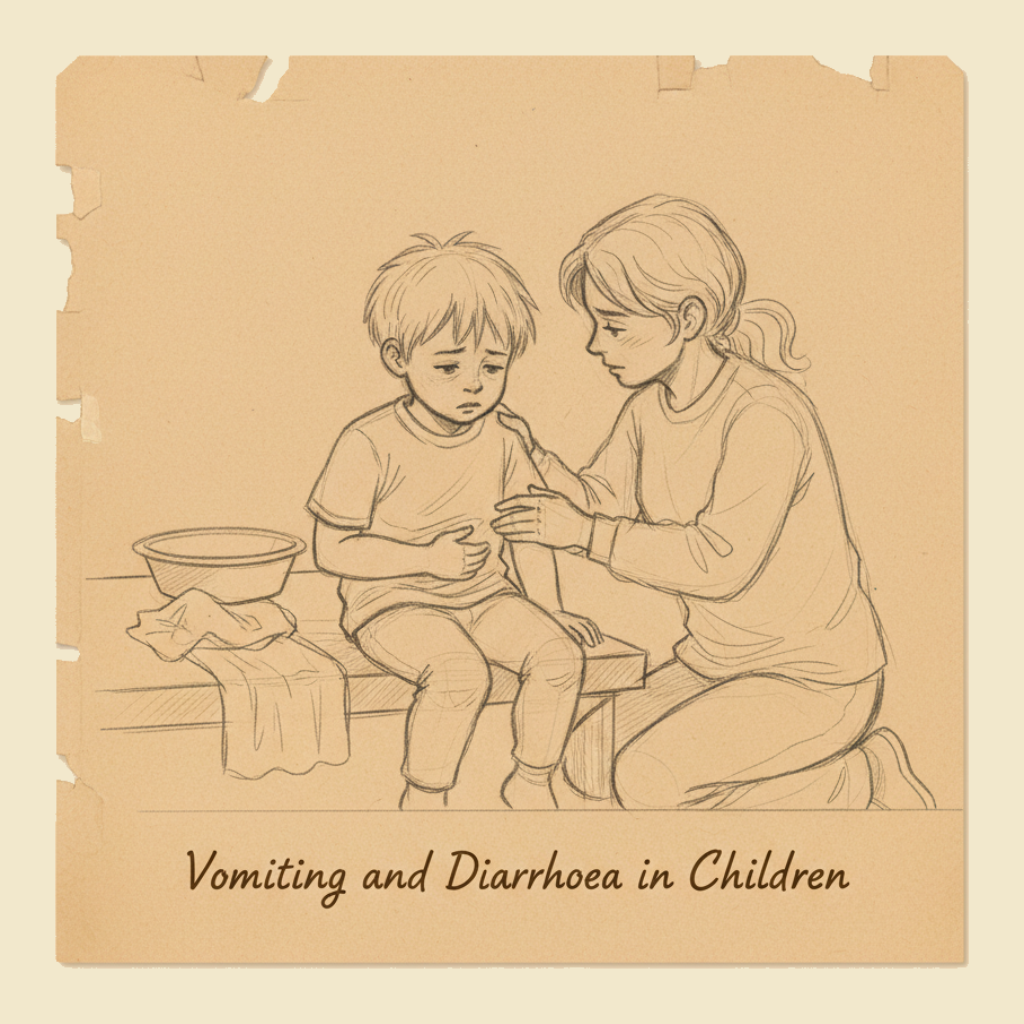
Why this is the chapter you will use most often
Across an entire year in an education and care service, the single most common reason a child suddenly becomes unwell during the day is gastroenteritis — inflammation of the stomach and intestines that produces vomiting, diarrhoea, or both. The cause is almost always a viral infection (rotavirus before vaccination became widespread, now norovirus, adenovirus, and others), occasionally a bacterial one, occasionally food-related, and sometimes the symptom of a different illness whose first sign happens to be a vomit or a runny nappy. G9.2.9
The first aider's job is to recognise the situation quickly, manage the child safely, prevent the infection from spreading to other children and staff, communicate with the parents, follow the exclusion policy, and watch for the small minority of cases that need more than service-level care. Most episodes are uncomfortable but harmless. A few are not. Knowing the difference is the chapter.
This chapter overlaps closely with the dehydration chapter (the most common complication), the infection control chapter (the response to the contamination), and the signs of acute illness in children chapter (the recognition that something more serious is going on).
§ Instructor's note
The teaching point is the routine of a common situation: assess the child, make them comfortable, isolate the infection, communicate with the parent, document, and watch for the red flags. Drill the rule: most episodes are viral and self-limiting; the things to watch for are dehydration, severe abdominal pain, blood, and any feature that does not fit gastroenteritis.
What gastroenteritis is
Gastroenteritis is inflammation of the stomach (gastritis) and/or the small intestine (enteritis), usually caused by an infection. The inflammation makes the gut work badly: it produces nausea, vomiting, abdominal cramps, and watery diarrhoea, often combined with fever, lethargy, and reduced appetite. The body is trying to expel the offending pathogen, and the symptoms are the consequence.
The most common culprits in children:
- Norovirus — the leading cause of viral gastroenteritis in all ages, extremely contagious, often runs through services in outbreaks. Sudden onset, vomiting prominent, usually 24 to 48 hours.
- Rotavirus — historically a major cause of severe gastroenteritis in young children, now much less common since rotavirus vaccination became standard at 2 and 4 months in Australia.
- Adenovirus — a slower, milder gastroenteritis, often combined with respiratory symptoms.
- Sapovirus, astrovirus — less common viral causes.
- Bacterial causes — Salmonella, Campylobacter, E. coli, Shigella, often from contaminated food. Bacterial gastroenteritis tends to be more severe, with bloody diarrhoea, high fever, and a more prolonged course.
- Parasitic causes — Giardia and others, usually from contaminated water; uncommon in well-managed Australian environments.
- Food poisoning — toxins produced by bacteria in food (Staphylococcus, Bacillus cereus). Sudden onset within hours of eating, vomiting prominent, usually short-lived.
- Non-infectious causes — food intolerance, food allergy (which can also produce vomiting and diarrhoea, see the allergic reaction chapter), chronic conditions like coeliac disease.
The first aider does not need to identify the specific cause. The first aider needs to recognise the pattern and respond.
Recognising vomiting and diarrhoea at the service
The signs are usually obvious: a child throws up, or has a runny nappy, or both. The recognition is in deciding what to do next, not in the diagnosis itself.
- A single vomit in an otherwise well child — could be many things. Coughing too hard, eating too fast, swallowed something disagreeable, motion-related, the start of a viral illness. Watch for any further developments.
- Repeated vomiting — more than one episode within a short time — is a clearer pattern. The child is in the early stage of an illness or has eaten something they cannot tolerate.
- A single loose or runny nappy — also could be many things, including normal variation. Watch.
- Repeated loose stools — clearer pattern. Diarrhoea, usually viral.
- Vomiting and diarrhoea together — gastroenteritis until proven otherwise.
- Fever combined with vomiting and diarrhoea — supports the gastroenteritis picture.
- Lethargy or unusual behaviour combined with the GI symptoms — supports a more significant illness.
- Abdominal pain combined with the symptoms — usually part of gastroenteritis but can also be a sign of more serious problems (see below).
Immediate management
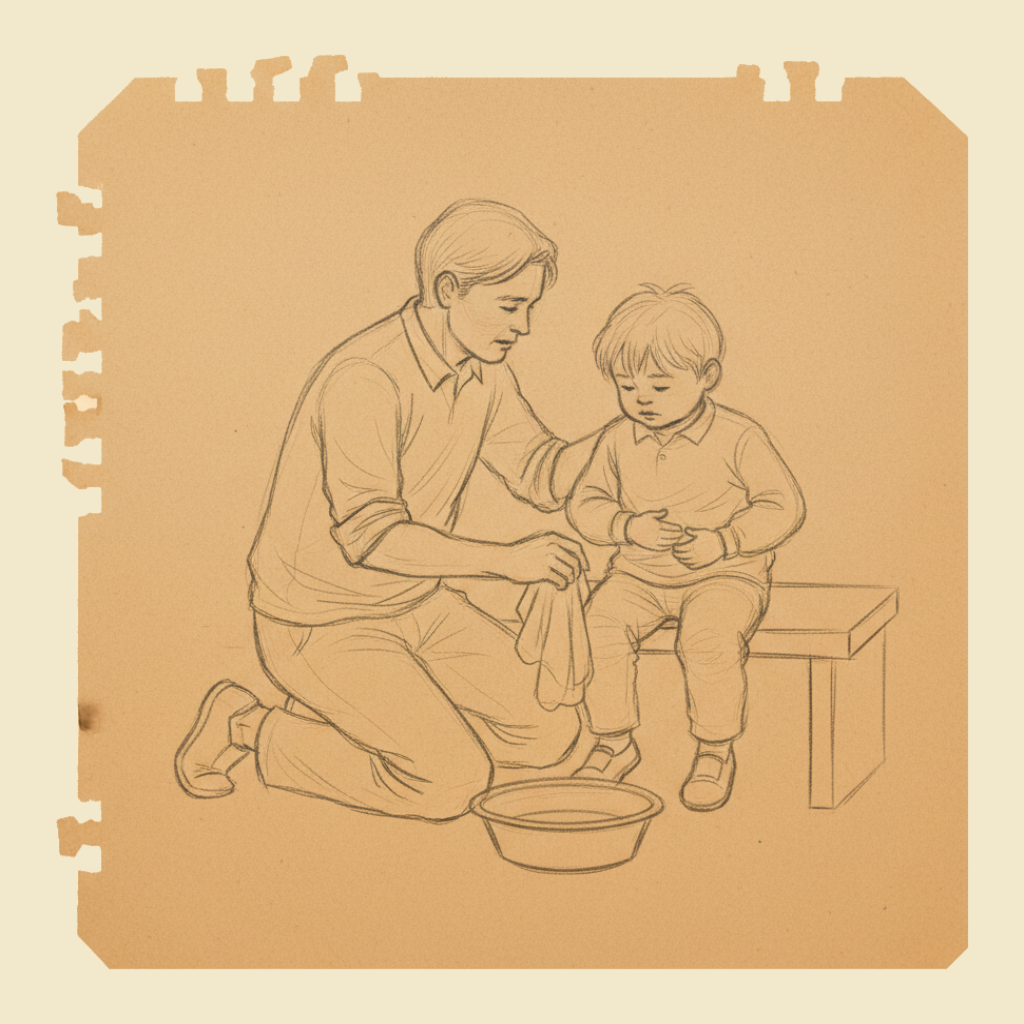
When a child vomits or has diarrhoea at the service, the response has two parallel tracks: looking after the child, and managing the contamination.
Looking after the child
- Stay with the child and reassure them. Vomiting is unpleasant and a young child may be frightened or embarrassed.
- Keep them comfortable — clean their face and hands, change soiled clothes, find a quiet space where they can rest.
- Keep them upright if they are still feeling sick. Lying flat increases the risk of vomiting again and aspirating. Sitting forward over a basin or bucket is the classic position.
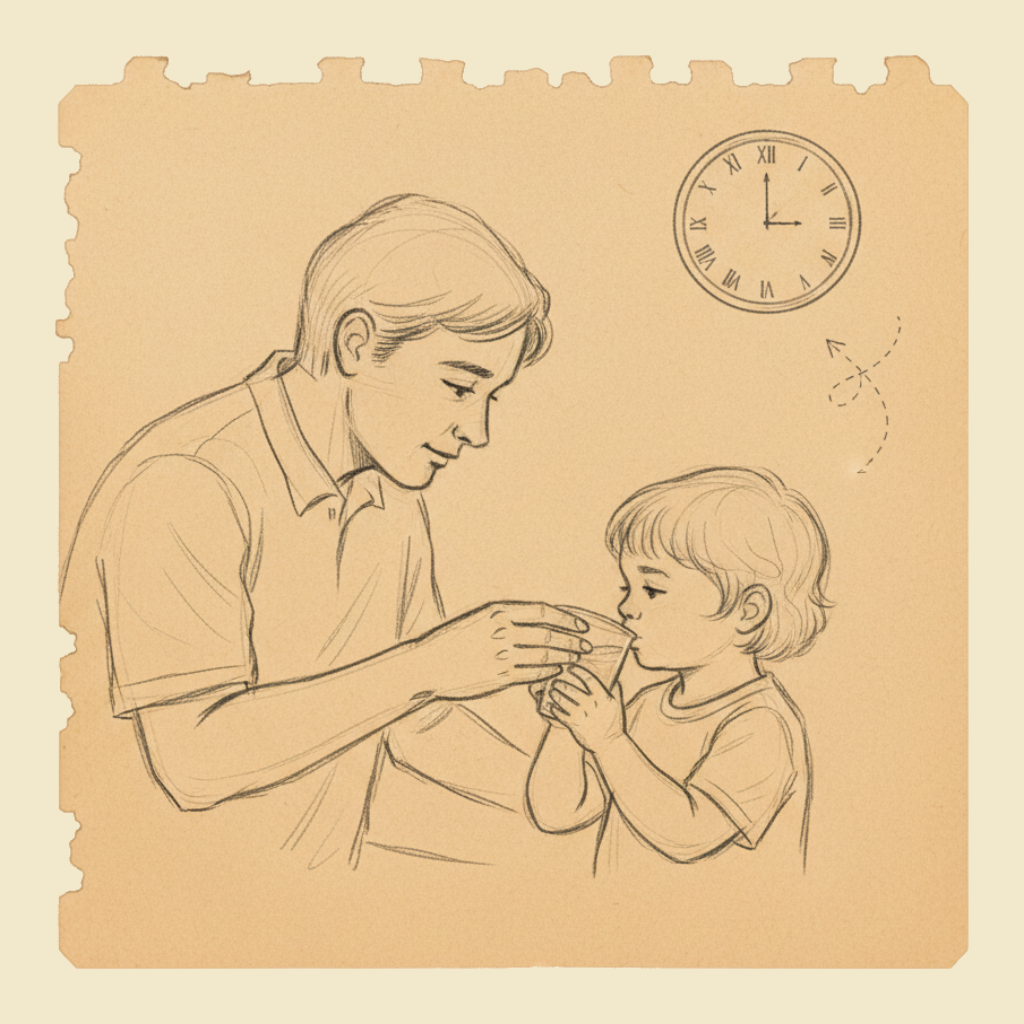
- Offer small sips of water once they are settled. Do not force fluids; small amounts at first to see if they stay down. If they vomit again immediately, wait 10 minutes and try smaller amounts.
- For a child with significant vomiting or diarrhoea, oral rehydration solution is the right fluid — see the dehydration chapter.
- Do not offer solid food until the vomiting has settled and the child wants to eat. The instinct to "give them something to eat" is wrong in the early stages.
- Notify the parent with a clear description of what happened, when, the child's current condition, and the request for collection. Most service exclusion policies require collection after vomiting or diarrhoea episodes — see below.
- Document the episode in the incident, injury, trauma and illness record.
- Continue to monitor until the parent arrives. Watch for any deterioration — increased vomiting, signs of dehydration, severe pain, drowsiness, or any other red flags.
Managing the contamination
Vomit and diarrhoea are infectious material and the response includes infection control to protect everyone else in the room:
- Use personal protective equipment — disposable gloves, an apron if available, and a mask if there is splash risk. See the infection control chapter.
- Move other children away from the contaminated area immediately. They do not need to see what is happening and they should not be exposed to the spillage.
- Clean the contaminated area promptly using the service's standard procedure — usually absorbent material first, then a cleaning agent appropriate for biohazardous spillage (often a 1:10 bleach solution or a commercial disinfectant rated for norovirus).
- Dispose of contaminated material in a sealed bag in the appropriate waste stream.
- Clean and disinfect surfaces in the area — floor, furniture, toys, anything that may have been splashed.
- Wash and disinfect any clothing that was contaminated, or seal it in a plastic bag for the parents to deal with at home.
- Hand hygiene — thoroughly wash and dry your hands after the cleanup, and require all children and staff in the area to wash hands.
- Document the incident including the cleanup steps for the service's records.
The procedure should be in your service's infection control policy. Read it, know it, and have the supplies ready before you need them.
When the parents come
The parents should be told:
- What happened — when the vomiting or diarrhoea started, how many episodes, what the child's general condition has been.
- What was done at the service — comfort, fluids, observation, contamination cleanup.
- The exclusion rule — the service's policy for return after gastroenteritis.
- The educator's recommendations — continued small sips of fluids, oral rehydration solution, watching for dehydration, and seeking medical advice if the child is not improving or has any red-flag features.
- Whether the educator thinks the child needs urgent medical attention — and if yes, why.
For most cases, the conversation is brief and the child goes home with a plan to rest, drink fluids, and return when the exclusion period is over. For the cases where the child is more unwell, the conversation is firmer and includes a clear recommendation for medical assessment.
The exclusion rule
Most ECEC services in Australia exclude children with gastroenteritis until they have been symptom-free for at least 24 hours (some services require 48 hours, particularly during outbreaks). The reasons:
- Children remain infectious for some hours after the symptoms stop, and longer for some pathogens. Returning too early spreads the infection.
- The child's gut is still recovering and they need rest, not the demands of a busy service.
- Other families have a reasonable expectation that the service is doing what it can to limit infectious disease.
- Staff health matters too — gastroenteritis spreads from children to educators easily, and a service that is short-staffed because educators are sick is bad for everyone.
The exact policy varies by service and by jurisdiction, but the 24-hour rule is the common minimum. Communicate it clearly and apply it consistently, even when parents push back. The push-back usually comes from parents who cannot easily take time off work, and the educator's job is not to solve the parent's logistical problem — it is to enforce the policy that protects the children and staff. Be kind, be firm, and refer disputes to the nominated supervisor.
Red flags — when the picture is more than gastroenteritis
Most vomiting and diarrhoea in children is benign viral gastroenteritis. The red flags that suggest something more serious is going on:
Signs of dehydration
The most common complication and the most important to recognise. See the dehydration chapter for the full list. Briefly: dry mouth, sunken eyes, sunken fontanelle in infants, no tears, decreased wet nappies, lethargy, slow capillary refill, cool extremities. Moderate signs need parent contact and medical assessment; severe signs need an ambulance.
Blood in vomit or stool
- Bright red blood in vomit — bleeding from somewhere in the upper digestive tract. Could be a small tear from forceful vomiting, or could be more serious. Always escalates to medical assessment.
- "Coffee ground" vomit — dark brown granular material that looks like coffee grounds. Old blood that has been in the stomach. Always serious.
- Bright red blood in stool — bleeding from the lower digestive tract, possibly from a fissure, infection, or more serious cause.
- Black tarry stool (melaena) — old blood from the upper digestive tract that has passed through the gut. Always serious.
- Mucus or pus in stool — can suggest bacterial or inflammatory causes.
Any of these warrants immediate parent contact and medical assessment.
Severe abdominal pain
Abdominal pain that is severe, persistent, or out of proportion to the gastroenteritis picture is a red flag. Possible causes include appendicitis, intussusception (where one segment of bowel telescopes into another, classic in children 6 months to 3 years), bowel obstruction, and others. See the pain chapter. Severe abdominal pain in a child is a parent contact at minimum and an ambulance for the more severe cases.
High fever
A high fever (over 39°C) combined with vomiting or diarrhoea, particularly if the child looks unwell, may indicate a more serious infection (bacterial gastroenteritis, urinary tract infection, septicaemia, meningitis). See the fever chapter for the assessment of fever and the red flags.
Drowsiness, reduced responsiveness, irritability that does not respond to comfort
A child who has been unwell with vomiting and diarrhoea and is now drowsy, lethargic, or unusually quiet is in trouble. The combination of dehydration and severe illness is a serious situation. Escalate immediately.
Bilious vomiting
Bilious vomiting — vomit that is yellow or green from bile — in a young child can indicate bowel obstruction and is always a serious sign. It is different from the watery or food-residue vomit of gastroenteritis. If you see bright green or dark yellow vomit in an infant or young child, this is a medical emergency.
Projectile vomiting in a young infant
A young infant (typically 2 to 8 weeks) with projectile vomiting — forceful vomiting that shoots out across the room rather than dribbling — combined with hunger and weight loss can have pyloric stenosis, a condition where the muscle at the outlet of the stomach is thickened and obstructs the flow. This is a surgical condition. Most ECEC services do not care for babies this young, but it is worth knowing.
Vomiting after a head injury
Vomiting in the hours after a head injury — particularly more than once, or combined with other neurological signs — can indicate a serious head injury. See the head neck spinal injuries chapter. Any vomiting after a head injury warrants medical assessment.
Symptoms that do not fit gastroenteritis
If a child has vomiting or diarrhoea but the rest of the picture does not fit — they have severe headache, neck stiffness, a non-blanching rash, unusual behaviour, focal weakness, or any other sign that does not match a routine viral illness — escalate. The vomiting may be a symptom of a different and more serious condition.
Vomit that contains bile (bright green or dark yellow) or blood (bright red, dark red, or coffee-ground appearance) in a child is not routine gastroenteritis. These signs can indicate bowel obstruction, severe upper digestive bleeding, or other serious conditions. Call the parents immediately, recommend urgent medical attention, and call 000 if the child looks seriously unwell or if the parents cannot collect quickly. Do not give food or fluids while waiting.
Special considerations for infants
Infants under 1 year are higher-risk for several reasons:
- They dehydrate faster. A morning of vomiting and runny nappies that would be a minor inconvenience in a 4-year-old can be a serious situation in a 6-month-old.
- They cannot tell you what they feel. The educator has to read the body and behaviour.
- They have a smaller fluid reserve and less compensation when they lose fluid.
- Some serious conditions of infancy (intussusception, pyloric stenosis, bowel obstruction) present with vomiting as the primary sign.
- Breastfed infants should continue to be breastfed during gastroenteritis — breast milk is well-tolerated, has anti-infective properties, and is the right rehydration fluid for a young baby.
- Formula-fed infants can usually continue formula, with oral rehydration solution offered between feeds if needed.
The threshold for parent contact and medical assessment should be lower for an infant than for an older child. A 6-month-old who has vomited twice and had three runny nappies in the morning is a phone call to the parent now, not later.
Outbreaks
When more than one or two children at the service develop vomiting or diarrhoea in a short time, the service may be in the middle of an outbreak — usually norovirus, occasionally something else. The response involves:
- Notification of the relevant state public health authority (the nominated supervisor's job, not the educator's, but worth knowing).
- Heightened infection control — more frequent cleaning, more aggressive handwashing, possibly closing affected areas of the service temporarily.
- Communication with all families — telling parents what is happening, what to watch for, when to keep their child home.
- Educator and child exclusion — affected staff and children are kept home for the full exclusion period to break the chain.
- Possible service closure in the most severe outbreaks, on advice from the public health authority.
Outbreaks are stressful and disruptive. The service has a plan; the educator's job is to follow it.
The most powerful infection control measure against viral gastroenteritis is plain old handwashing with soap and running water. Alcohol hand sanitiser is convenient but is not effective against norovirus, the most common viral cause of gastroenteritis outbreaks in Australian services. Soap and water work because the mechanical action of washing physically removes virus particles from the skin. Wash your hands before and after every nappy change, before food preparation, after toileting, after any contamination event, and at every other appropriate moment. The same rule applies to children — handwashing is taught, modelled, and supervised throughout the day.
Vomiting and diarrhoea in children are usually caused by self-limiting viral gastroenteritis and are managed with supportive care including small frequent fluids (preferably oral rehydration solution), rest, and observation. The first aider should watch for signs of dehydration, blood in vomit or stool, severe abdominal pain, high fever, drowsiness, and any sign that the child is significantly unwell. Infection control measures including hand hygiene, personal protective equipment, and the disinfection of contaminated surfaces are essential to prevent the spread of infection. Children with gastroenteritis should be excluded from group care until symptom-free for at least 24 hours.
What not to do
- Do not dismiss a vomiting or diarrhoea episode as "probably nothing". Most are mild but each one needs assessment, parent contact, and infection control.
- Do not give food or large fluids to a child who is actively vomiting. Small sips of water or oral rehydration solution, gradually.
- Do not give sugary drinks, fruit juice, or sports drinks for gastroenteritis. They make things worse.
- Do not delay parent contact. The exclusion policy and the parent's right to know start as soon as the symptoms appear.
- Do not clean up vomit or diarrhoea without proper PPE and the right cleaning agent. The risk of catching the infection yourself is real.
- Do not ignore red flags — bilious vomit, blood, severe pain, drowsiness, signs of dehydration, vomiting after head injury. Escalate.
- Do not allow a child to return to the service before the exclusion period is over, even if the parents are pushing for it.
- Do not treat a vomiting or diarrhoea outbreak casually. Notify, heighten controls, and follow the public health advice.
You will rehearse the response to a vomiting episode in a busy room — managing the child, isolating the spill, deploying PPE, cleaning the area, communicating with the parent, and applying the exclusion rule. You will also discuss the recognition of red flags and the escalation pathway when a "routine" gastroenteritis episode turns out to be something more.
Vomiting and diarrhoea are the most common reasons a child becomes acutely unwell at the service, and the response is mostly routine — comfort, fluids, infection control, parent contact, exclusion. The cases that need more are the ones with red flags: dehydration, blood, severe pain, bilious vomiting, drowsiness, anything that does not fit. Watch for them. Most of the time the answer is a phone call and a 24-hour rest at home; occasionally the answer is the ambulance. Treat the child kindly, protect the room, communicate clearly, and document everything.
— ANZCOR Guideline 9.2.9 (heat-related illness, with paediatric gastroenteritis principles)