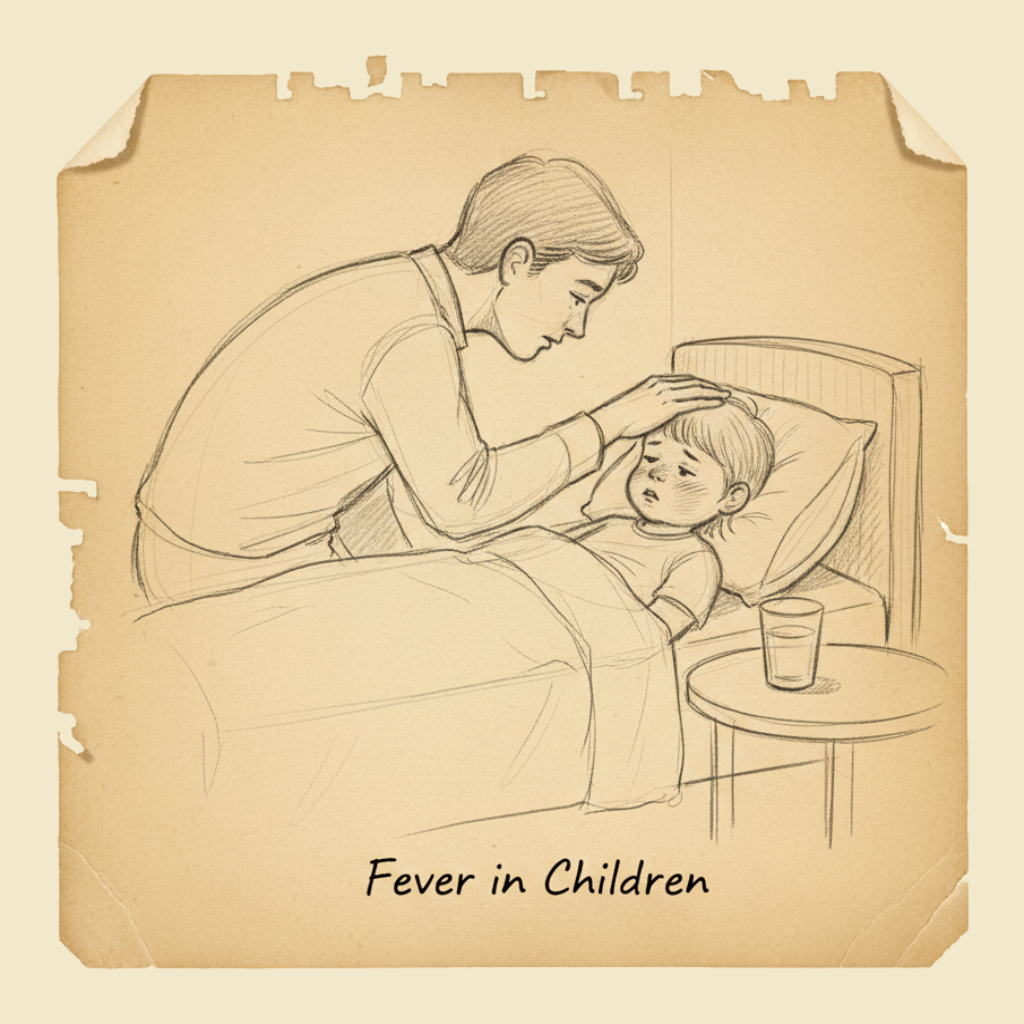
What a fever actually is
A fever is an elevation in body temperature above the normal range, controlled by the brain's temperature regulation centre (the hypothalamus) in response to an infection or inflammation. Fever is not a disease — it is a symptom and, more importantly, a defence mechanism. The raised temperature is the body's response to invading pathogens; it makes the immune system work more efficiently and makes the environment less hospitable for many bacteria and viruses. G9.2.9
This is the central misunderstanding about fever that the educator needs to get straight: a fever is not the enemy. It is the body's response to the enemy. The enemy is the underlying infection. Treating the fever — with paracetamol, with cooling, with all the things parents and educators reach for — does not treat the underlying problem. It makes the child more comfortable and is sometimes worth doing for that reason alone, but it does not make the child get better faster, and it does not prevent the complications that occasionally arise.
The first aider's job is to recognise that the child has a fever, recognise the situations in which the fever and the underlying illness need urgent attention, comfort the child, communicate with the parents, and follow the service's exclusion policy. The harder cases — febrile convulsions, severe dehydration, signs of serious infection — get their own chapters: see the febrile convulsions chapter, the dehydration chapter, and the signs of acute illness in children chapter.
§ Instructor's note
The teaching point of this chapter is the calibration: fever is common, fever is mostly benign, fever is the body doing its job, and the educator's response is comfort and observation in most cases. The exceptions — the child who looks really unwell, the very young infant, the child with other red flags — are where the response needs to escalate. Drill the rule: treat the child, not the number on the thermometer.
What counts as a fever
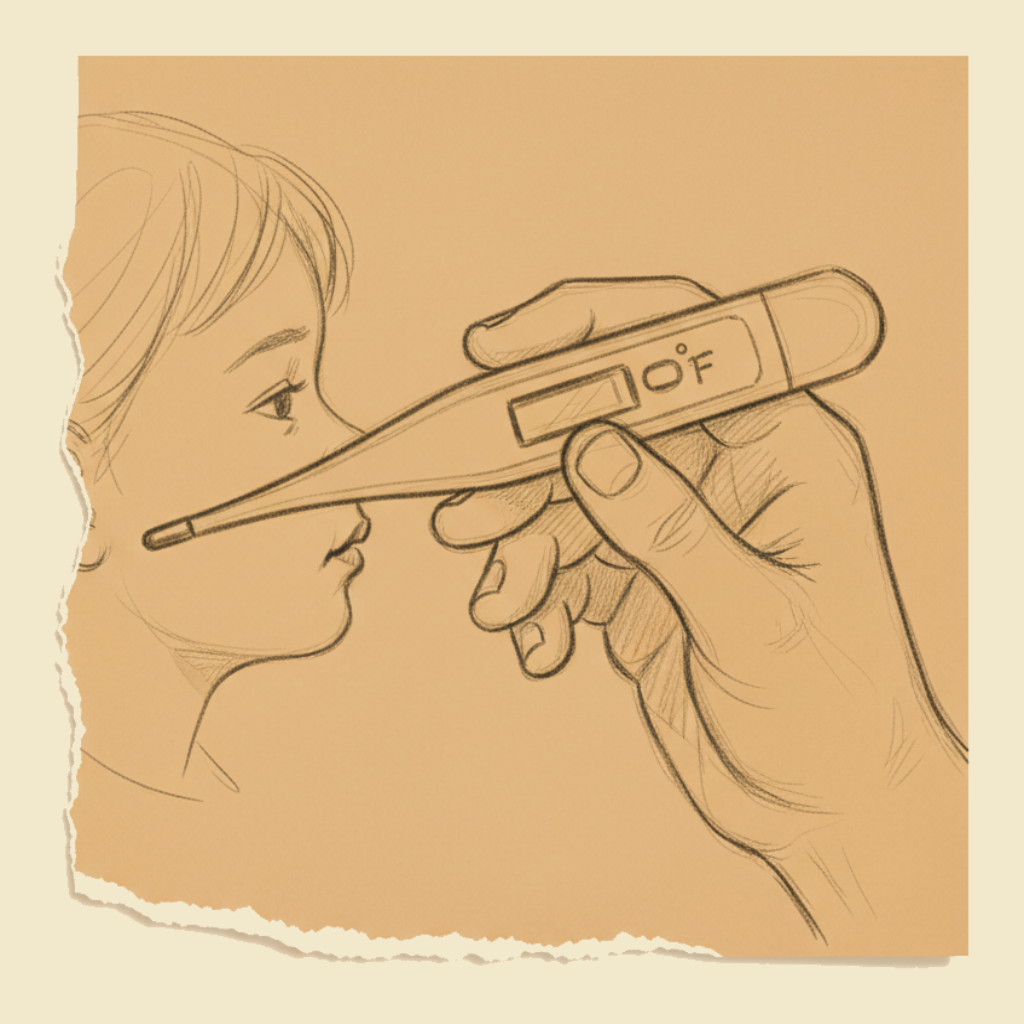
Normal body temperature is approximately 36.5 to 37.5°C, with some variation through the day (lower in the morning, higher in the late afternoon and evening) and some individual variation. The threshold for "fever" depends on the measurement method:
- Oral or under the tongue: 37.5°C or above.
- Axillary (under the arm): 37.2°C or above.
- Tympanic (in the ear): 38.0°C or above.
- Rectal: 38.0°C or above. Most accurate but rarely used in an ECEC setting.
- Forehead infrared scan: 38.0°C or above.
In practice, most services use a tympanic or forehead thermometer, both of which are quick and minimally distressing for the child. The exact technique matters — point the thermometer correctly, hold it for the right time, take more than one reading if you are uncertain. A reading from a poorly-applied thermometer is worse than no reading at all because it can give false reassurance or false alarm.
A common cut-off for "needs to go home" in ECEC services is around 38°C or above, but the right answer is always the service's specific exclusion policy, not a number applied without context. A child with a 37.8 who is also lethargic, refusing to drink, and miserable may need to go home; a child with 38.2 who is otherwise running around happily may be well enough to stay for a while with monitoring.
What causes a fever
In an ECEC setting, the overwhelming cause of fever is viral infection — the dozens of common childhood viruses that circulate through services and cause the cycle of colds, gastroenteritis, ear infections, croup, hand-foot-and-mouth, roseola, and the rest. Children get a lot of viral infections, particularly in their first year or two of group care, and the resulting fevers are part of how their immune systems develop.
Less commonly, fevers are caused by:
- Bacterial infections — ear infections, throat infections, urinary tract infections, pneumonia, skin infections. These often need antibiotic treatment but are usually not immediately life-threatening.
- Inflammatory conditions — far less common in young children.
- Immunisation reactions — many vaccines produce a low-grade fever for a day or two as the immune system responds. This is normal.
- Heat-related illness — overheating from external causes (hot day, too much clothing, dehydration, sustained exercise), which is a different mechanism. See the hyperthermia chapter. True heat illness is medically distinct from infectious fever.
- Serious bacterial infections — meningitis, septicaemia, severe pneumonia. Rare but the reason fever in a child should always be taken seriously when the child looks unwell.
The first aider does not diagnose the cause; the first aider recognises the fever, observes how the child is, and decides whether the situation needs medical attention, parent contact, or just comfort and monitoring.
"Treat the child, not the number"
This is the most important phrase in paediatric fever management. Two children with the same temperature can be in completely different situations:
- Child A has a temperature of 39.2, is sitting on the educator's lap, looks tired but is alert, drinks water when offered, and is content to play quietly for short periods. They have a snotty nose and a mild cough. Their parents have said they had the same thing yesterday and the doctor said it was a virus.
- Child B has a temperature of 38.4, is unusually quiet, refuses to drink, has a rash that did not blanch when pressed, has cool hands and feet despite the fever, and seems hard to engage. They were fine an hour ago.
The number is higher for Child A. The situation is more urgent for Child B. The number alone does not tell you how sick the child is. The clinical signs do.
The educator's assessment of a febrile child should focus on:
- General appearance — alert, engaging, looking around, recognising people, making eye contact. A bright child is usually a less worrying child.
- Activity level — playing, walking, asking questions vs. limp, withdrawn, sleeping much more than usual.
- Skin colour — pink and warm vs. pale, mottled, grey, or blue.
- Breathing — normal vs. fast, laboured, noisy. See the breathing difficulties chapter.
- Hydration — drinking, wet nappies, normal urine output vs. refusing fluids and reduced wet nappies. See the dehydration chapter.
- Eating — taking the usual amount vs. refusing food (a child who refuses food but still drinks is OK; a child who refuses both is more concerning).
- Crying and consolability — crying that responds to comfort vs. crying that does not, or a child who has stopped crying and is just lying there.
- Any rash — particularly a rash that does not blanch when pressed (the "tumbler test" — press a clear glass against the rash; a non-blanching rash stays visible through the glass and is a serious warning sign).
- Any unusual behaviour — confusion, lethargy, neck stiffness, photophobia (avoiding light), repeated vomiting, prolonged headache (in older children).
A child with fever who looks well and behaves well usually has a self-limiting viral infection and can be cared for at the service until pickup. A child with fever who looks unwell — by any of the indicators above — needs prompt parent contact and medical assessment.
Managing a febrile child at the service
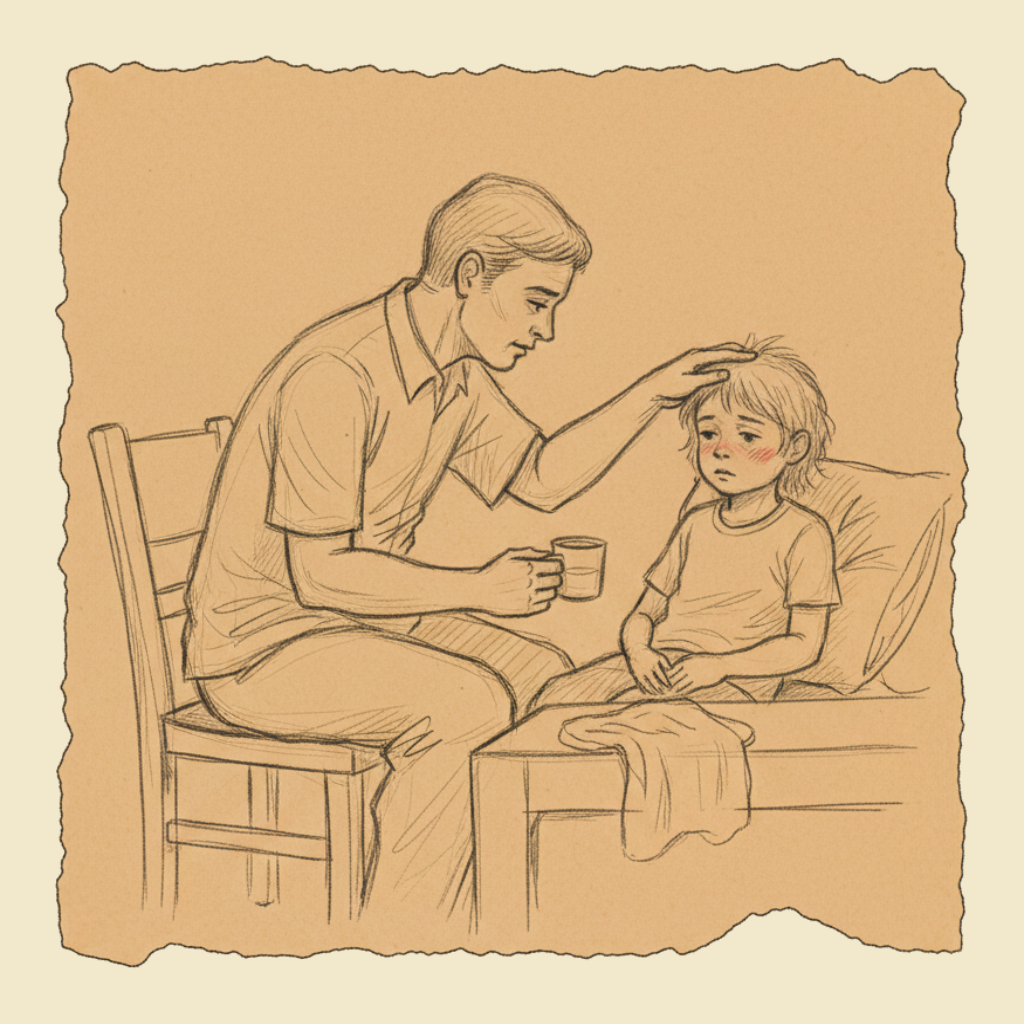
The everyday approach for a child with fever who is otherwise looking OK:
- Confirm the temperature with a reliable thermometer and a correct technique. Take a second reading after a few minutes to confirm.
- Observe the child for the clinical signs above, and form an overall impression of how unwell they look.
- Notify the parent with a clear description of the temperature, the time, and the child's general condition. Most services have a policy that triggers a phone call to the parent at a particular threshold (often 38°C or the child looking unwell, whichever comes first) — follow the policy.
- Make the child comfortable. Find a quiet space where they can rest. Remove excess clothing — fever is the body running hot, and bundling the child up in extra layers is the wrong instinct. A vest, a singlet, or light clothing is enough.
- Offer fluids in small frequent amounts. Water for an older child, breast milk or formula for a baby, an oral rehydration solution if you have one and the child has been losing fluid through vomiting or diarrhoea.
- Cool the environment gently. Open a window, use a fan (not pointed directly at the child), turn off any heating. Do not put the child in a cold bath, do not use ice water, do not use alcohol rubs. The cooling should be gradual and comfortable.
- A cool damp cloth on the forehead, neck, or wrists is comforting for some children and is fine if the child likes it. It does not significantly reduce body temperature but it makes the child feel better, which is the goal.
- Document the episode — temperature readings, the time, the clinical signs, the parent contact, and the outcome.
- Continue to observe until the parent arrives or the child is collected. Re-check the temperature periodically. Watch for any deterioration that would change your assessment.
Paracetamol and ibuprofen — the educator's role
Most children with fever at home are given paracetamol (Panadol, Dymadon) or ibuprofen (Nurofen) by their parents to make them more comfortable. The drugs do not cure the underlying infection and they do not prevent complications — they bring the temperature down somewhat and reduce the discomfort.
In an education and care service, the educator does not administer paracetamol or ibuprofen unless the medication has been specifically authorised for that child on the medication form, in line with the parents' written instructions and the service's medication policy. The reasons:
- The wrong dose can be harmful — paracetamol overdose is particularly dangerous and the dose depends on the child's weight. The educator is not in a position to calculate a correct dose without specific authorisation.
- The medication can mask symptoms that would otherwise alert a parent or doctor to a serious problem. A child who has been given paracetamol may appear better than they actually are, and the underlying illness can progress unnoticed.
- The medication policy of the service requires written parental authorisation for any medication, and over-the-counter medications are not exempt.
- The parent may have a reason the child should not have a particular drug — an allergy, a contraindication, a medical condition, or just a preference.
The right answer is to call the parent, describe the situation, and let them decide whether to come and collect the child or instruct the service in some other way. If the parent specifically authorises the educator to give paracetamol that is on the child's medication form, the educator follows the instructions. If not, the educator does not give the medication.
For the child with a known condition that requires fever management — for example, a child with a history of febrile convulsions whose parents have provided written instructions to give paracetamol at a particular temperature — the medication form covers it and the educator follows the plan. See the emergency action plans chapter.
Aspirin (acetylsalicylic acid) is associated with Reye syndrome, a rare but serious condition affecting the liver and brain, particularly in children with viral infections. Aspirin is not given to children under 16 with fever or viral illness, ever, except under specific medical instruction. The default fever drugs in children are paracetamol and ibuprofen, both of which are safe in correct doses. The educator does not need to know the dosing — that is the parent's and the doctor's job — but the educator should know that aspirin is not on the table.
When fever is a red flag
A child with fever should be the subject of an urgent phone call to the parent (and possibly an ambulance) if any of the following apply:
- The child is under 3 months old. Fever in a very young infant is always serious because the immune system is immature and serious bacterial infections present subtly. Any temperature of 38°C or above in a baby under 3 months is a hospital visit. Most services do not care for babies this young, but it is worth knowing.
- The child is 3 to 6 months old with a temperature of 39°C or above. Same reasoning, lower threshold for action.
- The child looks unwell — pale, mottled, lethargic, hard to rouse, not engaging, not interested in surroundings. Any of these in a febrile child is a red flag regardless of the temperature.
- The child has a non-blanching rash — small purple or red spots that do not fade when pressed with a clear glass. This can be a sign of meningococcal disease or other serious infection. Call 000 immediately.
- The child has neck stiffness, severe headache, photophobia (avoiding light), or repeated vomiting. These can be signs of meningitis. Urgent medical assessment.
- The child has fast or laboured breathing, particularly with the work-of-breathing signs in the breathing difficulties chapter.
- The child is severely dehydrated — see the dehydration chapter.
- The child has had a seizure. See the febrile convulsions chapter.
- The fever is very high and not responding — typically over 39.5 to 40°C and the child looking miserable.
- The fever has lasted more than a few days without improvement, or has come back after seeming to settle.
- The child has a known underlying condition (immunosuppression, congenital heart disease, chronic illness) that makes them vulnerable to infection.
For most of these, the answer is for the parent to take the child to the doctor or hospital today. For the non-blanching rash, suspected meningitis, severe respiratory distress, or any child who is critically unwell, call 000 directly and let the ambulance take over.
The "tumbler test" is a quick check for a non-blanching rash. Press the side of a clear glass against the rash and look through the glass. A normal rash (most viral rashes, hives, prickly heat) blanches — the redness disappears when pressed and reappears when released. A non-blanching rash (small purple or red spots, called petechiae) stays visible through the glass and does not fade. A non-blanching rash in a febrile child is a possible sign of meningococcal disease and is a medical emergency. Call 000, do not wait for the parent, and stay with the child.
Exclusion from the service
Most ECEC services have an exclusion policy for unwell children. The general rule is that a child with a fever should not be at the service (or should be sent home) — both for the child's comfort and to reduce the risk of spreading infection to other children and staff.
The specific rules vary by service and by jurisdiction (state health departments publish exclusion guidelines for various conditions), but a typical pattern is:
- A child with a fever of 38°C or above is sent home and is excluded from the service until they have been fever-free for at least 24 hours without the use of fever-reducing medication.
- A child with vomiting or diarrhoea is excluded for at least 24 hours after the last episode.
- A child with a known infectious illness (chickenpox, hand-foot-and-mouth, gastroenteritis, conjunctivitis, etc.) is excluded for the period set out in the relevant state health department guidance and the service's exclusion policy.
- A child who is not well enough to participate in the program is sent home regardless of whether they have a specific named illness.
The exclusion is not punitive. It is for the child (who needs rest and one-on-one care from a parent) and for the other children (who deserve not to be exposed to an infectious illness if it can be avoided). Communicate the rule kindly and consistently. Most parents understand once it is explained.
Comforting a febrile child
Beyond the technical management, the febrile child needs comfort:
- A quiet space — lower light, less noise, fewer other children. The sick bay or a quiet corner.
- A familiar adult — the educator the child is most attached to, where possible.
- A favourite comfort item if the child has one at the service (a blanket, a soft toy).
- Calm voice and gentle touch — sit at the child's level, speak slowly, do not crowd them.
- Patience — a sick child is more easily upset than usual, and the educator's job is to absorb that without taking it personally.
- Honest information — "Mummy is on her way to take you home soon" is reassuring and true. Avoid promises you cannot keep.
The child often just wants to be held. If the child is comforted by being held, hold them. Closeness with a familiar adult is often the single most effective comfort measure.
Fever in a child is an elevation in body temperature in response to infection or inflammation, and is distinct from heat-related illness, in which body temperature rises because of failure of the body's heat-regulating mechanisms. The first aid management of fever is to make the child comfortable, ensure adequate fluids, and seek medical assessment for any child who looks seriously unwell, has signs of dehydration, has a non-blanching rash, has had a seizure, or has any other red-flag features. Antipyretic medications such as paracetamol may be given by the parent or under specific authorisation; they reduce discomfort but do not treat the underlying cause and do not prevent complications.
What not to do
- Do not treat the number on the thermometer in isolation. The child's clinical condition matters more.
- Do not bundle a febrile child up in extra clothing or blankets. Less clothing is more comfortable and helps cooling.
- Do not put a febrile child in a cold bath or use ice water. Gentle cooling only.
- Do not give paracetamol or ibuprofen without specific authorisation on the medication form.
- Do not give aspirin to any child with a fever or viral illness. Ever.
- Do not ignore a non-blanching rash. Call 000.
- Do not dismiss a child who "looks unwell" because the temperature is not particularly high. The look matters.
- Do not dismiss a high temperature in a child who looks well, either — the child still needs the parent informed and the exclusion policy followed.
- Do not allow a febrile child to remain at the service when the policy says they should be sent home.
You will rehearse the assessment of a febrile child in role-play, using the clinical signs to distinguish a routine viral fever from a child who needs urgent attention. You will also practise the conversation with a parent who would prefer their unwell child stayed at the service rather than being collected — a common and difficult conversation that benefits from a calm, kind, firm script.
Fever is the body fighting an infection, not the infection itself, and most fevers in young children are part of normal viral illness that will resolve on its own. The first aider's job is to recognise the fever, look at how unwell the child looks, comfort them, communicate with the parents, and follow the exclusion policy. The exceptions — the child with red flags, the very young infant, the non-blanching rash, the seizure — are where the response escalates. Treat the child, not the number, and trust your eyes more than the thermometer.
— ANZCOR Guideline 9.2.9 (heat-related illness, with paediatric fever discussion)