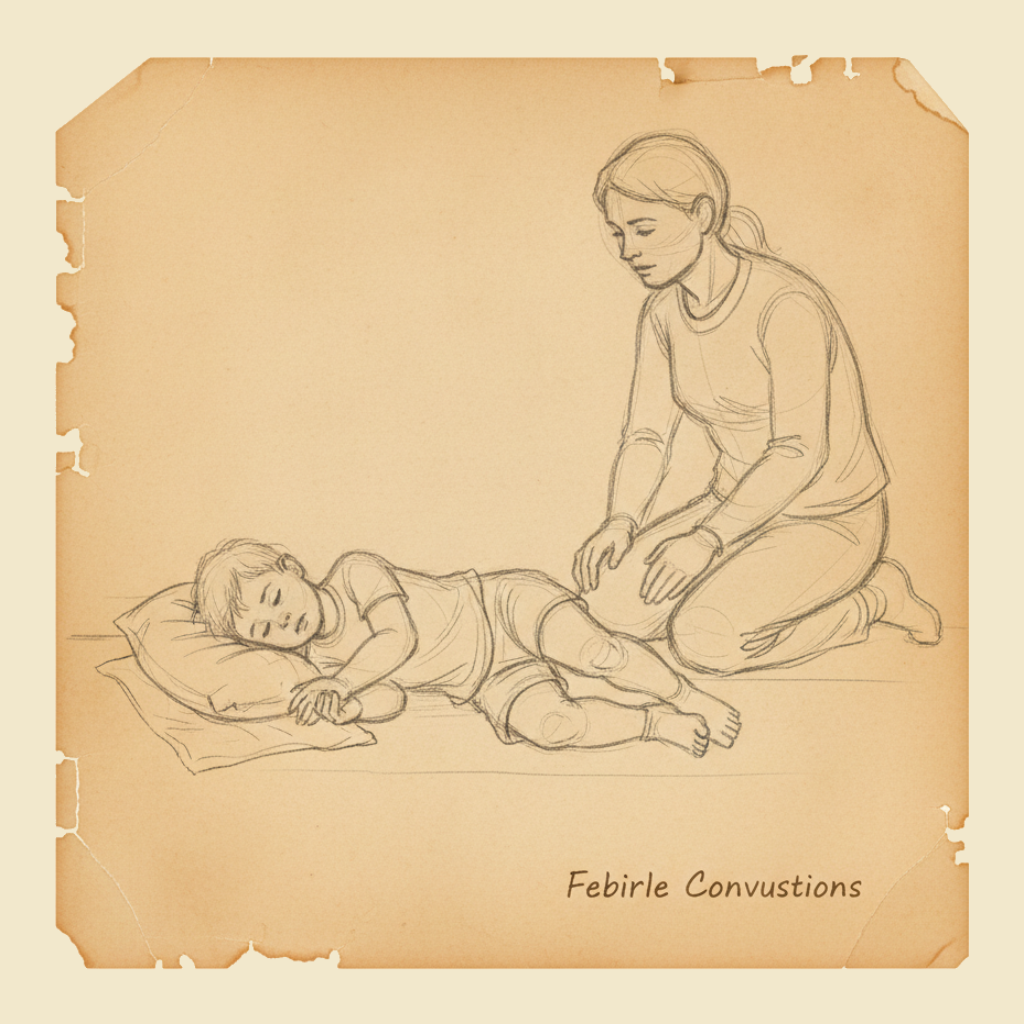
What a febrile convulsion is
A febrile convulsion (also called a febrile seizure) is a seizure triggered by a fever in a child between roughly 6 months and 6 years old. The child has no underlying brain disease and no seizure disorder; the seizure is the brain's response to a rapid rise in body temperature, usually from a viral infection. About 3% of children have at least one febrile convulsion before they outgrow them, and the great majority recover completely with no lasting effect. G9.2.2
For an educator who has never seen one, a febrile convulsion is a deeply alarming event. The child suddenly goes stiff or limp, may shake rhythmically, may stop breathing momentarily, and may turn blue or pale. It looks like a serious neurological emergency. The reality is that the typical febrile convulsion is short, self-limiting, and benign — but the educator's job in the moment is the same as for any seizure: protect the child from injury, time the seizure, manage the airway after it stops, and call for help. The detail of the general seizure response is in the seizures chapter, and the underlying fever management is in the fever chapter.
§ Instructor's note
The teaching point is that febrile convulsions are common, mostly benign, and almost always recover fully — but they are a real seizure that needs the standard seizure response in the moment, and they are a strong reason to call for medical assessment afterwards (because the underlying fever needs investigation and because a small minority of seizures in young children are not "just febrile"). Drill the rule: protect, time, position, recover, refer.
Why a fever causes a seizure
Children's brains are still developing, and the developing brain has a lower threshold for seizure activity in response to certain triggers. A rapid rise in body temperature is one of those triggers in a small percentage of children. The exact mechanism is not fully understood, but it appears to involve immature brain electrical regulation that can be tipped into a generalised seizure by the speed (and possibly the height) of the temperature rise.
What this means in practice:
- It is the rate of rise of the fever that matters more than the absolute height. A child whose temperature shoots up from 37 to 39.5 in an hour is more at risk than a child who has been at 39 for several hours.
- The seizure may be the first sign that the child has a fever — sometimes the seizure happens before anyone has noticed that the child is unwell. This is part of what makes them frightening: a child who was playing happily a few minutes ago suddenly has a seizure.
- The underlying cause is usually a viral infection — a cold, an ear infection, gastroenteritis, roseola, or any other common childhood illness with fever. Less commonly the cause is bacterial (pneumonia, urinary tract infection, occasionally meningitis), and the medical assessment afterwards is important to rule out the more serious causes.
- Children who have had one febrile convulsion are at higher risk of having another — perhaps a 30 to 35% recurrence rate — but they are not significantly more likely than other children to develop epilepsy in adulthood. The vast majority outgrow febrile convulsions by age 6.
What a febrile convulsion looks like
The typical (or simple) febrile convulsion has these features:
- Sudden onset — often without warning. The child may have looked unwell or fevered, or may have looked perfectly fine.
- Loss of consciousness — the child does not respond, does not make eye contact, does not react to voice or touch.
- Generalised body involvement — both sides of the body, both arms and legs.
- Stiffness (tonic phase) — the body goes rigid, the back may arch, the limbs may extend or flex, the eyes may roll up.
- Rhythmic shaking (clonic phase) — the limbs jerk in a rhythmic, repetitive pattern. The face may twitch. The tongue may be bitten.
- Breathing changes — the child may stop breathing momentarily, breathe noisily, or have changes in skin colour from pale to blue.
- Loss of bladder or bowel control is possible.
- Duration — typically less than 5 minutes, often less than 2 minutes. A simple febrile convulsion is by definition under 15 minutes.
- Single episode — one seizure, not a series.
After the seizure stops, the child enters a post-ictal phase of confusion, sleepiness, or unresponsiveness for some minutes (sometimes up to half an hour). They gradually wake up, may not remember the episode, may be tired, irritable, or want to sleep. Their colour returns and breathing normalises.
A complex febrile convulsion has one or more of the following features and is more concerning: lasting more than 15 minutes, involving only one side of the body, recurring within 24 hours, or being associated with neurological abnormalities. Complex febrile convulsions need a more thorough medical investigation. The first aider's job is the same in both cases — the distinction is made by the medical staff afterwards.
What to do during the seizure
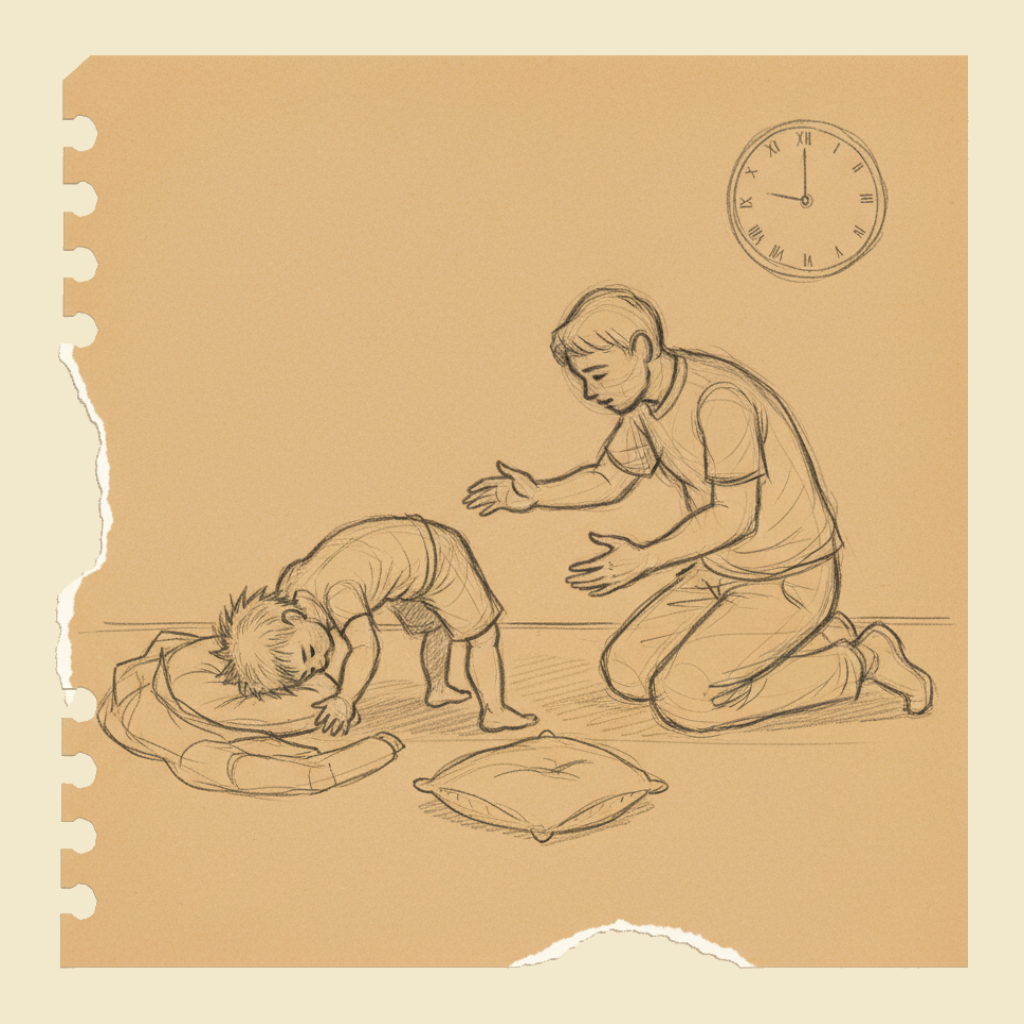
The educator's response to a febrile convulsion is the same as for any seizure: protect the child from injury, do not restrain, do not put anything in the mouth, time the seizure, and let it run its course.
- Stay with the child. Send another educator to call for help and to alert the nominated supervisor and the parent. Do not leave the child alone.
- Note the time the seizure started. This is important. If you have a phone, glance at it; if not, remember the approximate time.
- Move objects out of the way that the child could hit during the shaking — chairs, toys, hard or sharp items. If the child is on a hard surface (concrete, lino), put something soft under the head if you can do so without restraining.
- Do not restrain the child. Holding them down or trying to stop the shaking does not help and can cause injury. The seizure will run its course; your job is to make the environment safe.
- Do not put anything in the mouth. No spoon, no finger, no pen, nothing. The old advice about preventing tongue-biting is wrong and dangerous — it breaks teeth, causes the child to bite the rescuer, and can obstruct the airway.
- Do not try to stop the seizure with cold water, slapping, shouting, or any other intervention. None of these work and they can cause harm.
- Move other children away to give the casualty space and to spare the witnesses. A second educator's job is usually to manage the rest of the room.
- Loosen tight clothing around the neck if you can do so without restraining the child.
- Watch the breathing — the child may breathe noisily, irregularly, or briefly stop. This is part of the seizure and usually self-corrects. If the child genuinely stops breathing for more than 10 to 15 seconds after the seizure clearly stops, that is a serious sign and needs immediate response.
- Note what the seizure looked like — the body parts involved, the duration, any colour changes, any breathing changes. This is useful information for the medical staff.
The seizure is usually over in a couple of minutes. It will feel longer than it is — time stretches when you are watching a child seize.
What to do after the seizure stops
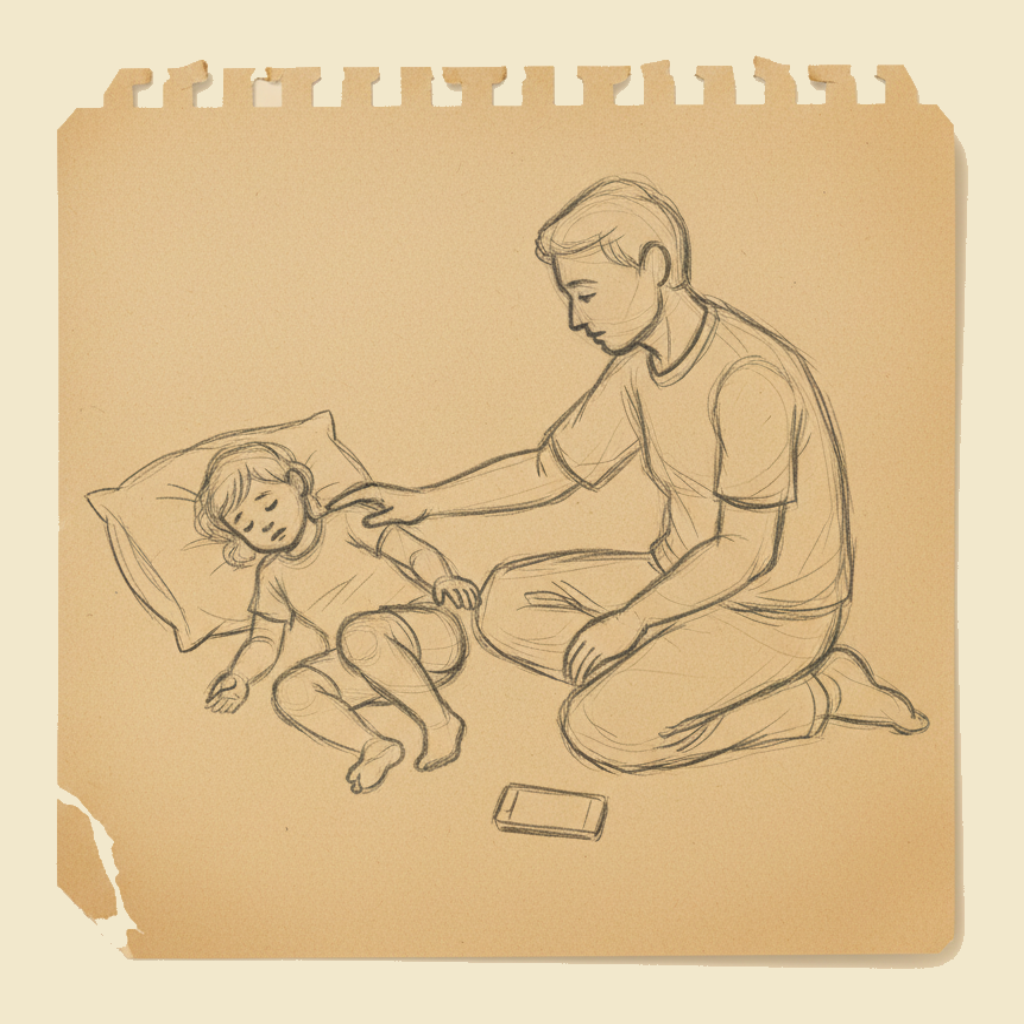
Once the shaking has stopped and the child is no longer actively seizing:
- Place the child in the recovery position — on their side, head tilted slightly back, mouth pointing toward the ground. This protects the airway from any saliva, vomit, or aspiration during the post-ictal phase. See the side position chapter.
- Check breathing. Look, listen, feel. Most children resume normal breathing immediately after the seizure ends. If breathing is normal, leave them in the recovery position and continue to monitor.
- Monitor the airway and breathing continuously. The post-ictal child may vomit and is at risk of aspiration. The recovery position is the protection against this.
- Cool the child gently — remove excess clothing, open windows, place a cool damp cloth on the forehead or neck. Do not plunge the child into a cold bath; the goal is gradual cooling, not shock. See the fever chapter.
- Reassure the child as they wake up. They may be confused, scared, tearful, or want a parent. Speak softly, use familiar names, sit at their level, and let them recover at their own pace.
- Do not give anything to eat or drink until the child is fully alert and able to swallow safely. The post-ictal child is not the right candidate for fluids.
- Continue to monitor until the parents arrive or the ambulance takes over.
When to call 000
A simple febrile convulsion that ends within a couple of minutes and is followed by gradual recovery does not always need an ambulance — but there are several situations in which the answer is to call 000 immediately:
- The seizure lasts more than 5 minutes. A long seizure is a serious problem and needs hospital management. The cut-off is sometimes set higher (10 minutes), but if you find yourself wondering, the answer is to call.
- The child has a series of seizures rather than a single one — multiple episodes within a short time, or one seizure that stops and another begins shortly afterwards.
- The child is not breathing normally after the seizure has stopped, or the breathing is severely impaired.
- The child does not wake up within 15 to 30 minutes of the seizure stopping, or remains drowsy and unresponsive long after the seizure should be over.
- This is the child's first seizure. A child who has never had a febrile convulsion before needs medical assessment, and an ambulance is a reasonable way to get there.
- You suspect any cause other than fever — head injury, ingestion of a toxic substance, an underlying condition the child has been treated for.
- The child is under 6 months or over 6 years old — outside the typical age range for febrile convulsions, the seizure is more likely to have a serious cause.
- You cannot reach the parent and the child needs medical care.
- You are uncertain. Calling 000 is the right answer when the situation is beyond what you can confidently manage. Better an ambulance attends and the child is fine than the opposite.
Even when an ambulance is not strictly necessary, the parent should be told immediately and the child should see a doctor the same day. A first febrile convulsion always warrants medical assessment to confirm the cause of the fever and to rule out more serious problems.
A seizure that does not stop within 5 minutes is in the territory of status epilepticus, which is a true neurological emergency. The brain is at risk from prolonged seizure activity, and the longer it goes on, the harder it becomes to stop. If a child's febrile convulsion is still going at 5 minutes, call 000 immediately. Do not wait to see if it stops on its own; the call is the right action whether the seizure ends 30 seconds later or not.
Cooling the child — yes, but gently
The fever that triggered the seizure is still there after the seizure ends. Cooling the child is part of the response, but it has to be done gently:
- Remove excess clothing — strip down to a vest or nappy/underwear.
- Cool the room — open a window, turn on a fan (not pointed directly at the child), reduce ambient heat.
- Apply a cool damp cloth to the forehead, neck, or wrists. Lukewarm water is fine; ice water is not.
- Offer cool fluids once the child is fully awake and able to swallow safely.
- Paracetamol (Panadol) or ibuprofen (Nurofen) can be given by the parent at home in line with the dosing on the label. The educator usually does not administer these without specific authorisation on the child's medication form.
What not to do:
- Do not put the child in a cold bath or pour cold water over them. This can cause vasoconstriction and a rebound increase in core temperature, plus shock and shivering.
- Do not use ice packs directly on the skin — they can cause skin damage and shivering, which generates more heat.
- Do not use alcohol rubs — old advice that is now considered harmful (alcohol absorbs through the skin, particularly in young children, and the cooling is uneven).
- Do not aim to bring the temperature down rapidly to normal. Gentle, gradual cooling is the goal. The aim is to make the child more comfortable, not to crash the fever.
Talking to the parents
Phoning a parent to say "your child has just had a seizure" is one of the harder calls an educator makes. The parent will be terrified. The technique:
- Lead with the present state — "Sam is awake now, breathing normally, and being looked after. He had a seizure a few minutes ago and we want you to come immediately."
- Be specific about what happened — when it started, how long it lasted, what you saw, what you did.
- Reassure with realistic information — "We think this is a febrile convulsion, which is when a fever causes a seizure in young children. They are usually not as serious as they look, but he needs to be seen by a doctor today."
- Be clear about what they should do next — come to the service and take Sam to the doctor or hospital, or wait for the ambulance which is already on the way.
- Avoid words that imply diagnosis you cannot make. "Fit", "epilepsy", "convulsion" are all words that frighten without precision. "Seizure" is the technically correct word.
The parent may want to talk to the child on the phone, or may want a more detailed description, or may need someone else to drive them to the service because they are too distressed. Let the conversation take whatever shape the parent needs. Stay calm; your calm voice on the phone is part of the care.
After the event — follow-up at the service
Once the immediate situation is resolved (the parent has the child, or the child has gone to hospital), the service should:
- Document the event in detail in the incident, injury, trauma and illness record. Include the time, the duration, the description, the response, the personnel involved, the parent contact, and the outcome. This is a serious incident under the Education and Care Services National Law and is likely to be a notifiable incident — see the education and care services national law chapter.
- Notify the Regulatory Authority through the nominated supervisor, in line with the prescribed timeframes.
- Debrief the staff who witnessed the event. A child seizure is distressing for the educators who saw it. The structured debrief, and ongoing support if needed, is in the rescuer and child stress support chapter.
- Reassure the other children who saw the event. Honest, simple explanation of what happened and that the child is being looked after. Allow questions.
- Communicate with the wider parent community if appropriate, in line with the service's communication policy and respecting the privacy of the casualty's family.
- Update the child's individual file and medical information when you receive the medical follow-up from the parents, including any new action plan if one has been provided.
Most children who have a febrile convulsion at the service can return to care in a day or two, once the underlying illness has resolved. Some parents will be very anxious about a return — particularly if it was a first seizure — and the service may need to discuss the management plan with them, including any specific instructions from the doctor.
A child who has had a febrile convulsion before may have a recurrence at the service, particularly if they develop a fever during the day. The parents may have provided specific instructions or an action plan, including the recognition signs to watch for and the early administration of paracetamol or ibuprofen if the child develops a fever. Follow the action plan, and do not be alarmed by the history — knowing the child has had one before makes you better prepared, not more at risk. The service should keep the action plan with the child's records and make sure all educators who care for the child know it exists.
A seizure in a child should be managed by protecting the child from injury, not restraining the child, not placing anything in the mouth, and timing the duration. The recovery position should be used after the seizure ends to protect the airway. Emergency medical care should be sought for any seizure lasting more than five minutes, any series of seizures, any seizure followed by prolonged unresponsiveness or absent breathing, any first seizure in a child, and any seizure with concerning features. Febrile convulsions in young children are usually self-limiting and benign but always warrant medical assessment because of the underlying febrile illness.
What not to do
- Do not restrain the child during the seizure. Let it run its course.
- Do not put anything in the child's mouth. Tongue-biting is much less harmful than the consequences of intervention.
- Do not plunge the child into a cold bath or use ice water. Gentle cooling only.
- Do not assume a febrile convulsion is "just" a febrile convulsion until a doctor has assessed the child. The same response works whatever the cause.
- Do not delay calling 000 if the seizure lasts more than 5 minutes, recurs, or the child does not recover normally.
- Do not give food or drink to a post-ictal drowsy child. Wait until they are fully alert.
- Do not dismiss a parent's anxiety. A seizure is genuinely frightening and the parent's response is normal.
- Do not forget the documentation, the notification, and the staff debrief afterwards.
You will rehearse the seizure response on a paediatric manikin — protecting the child, timing the seizure, avoiding restraint, moving to the recovery position once the seizure ends, and managing the post-ictal airway. The instructor will also walk you through the conversation with a frightened parent on the phone. The technique is simple; the calm under pressure is the part that benefits from practice.
A febrile convulsion is a frightening event with a usually reassuring outcome. The child seizes because their developing brain has reacted to a rapid rise in fever, the seizure passes within a few minutes, and the recovery is usually complete. The first aider's job is the standard seizure response — protect, do not restrain, time it, place in the recovery position, monitor — followed by gentle cooling and a phone call to the parent. Call 000 for any seizure over five minutes, any first seizure, or any seizure that does not behave like a simple febrile convulsion. And after it is over, look after yourself and the other educators who saw it.
— ANZCOR Guideline 9.2.2 (first aid for seizures)