What an emergency action plan is
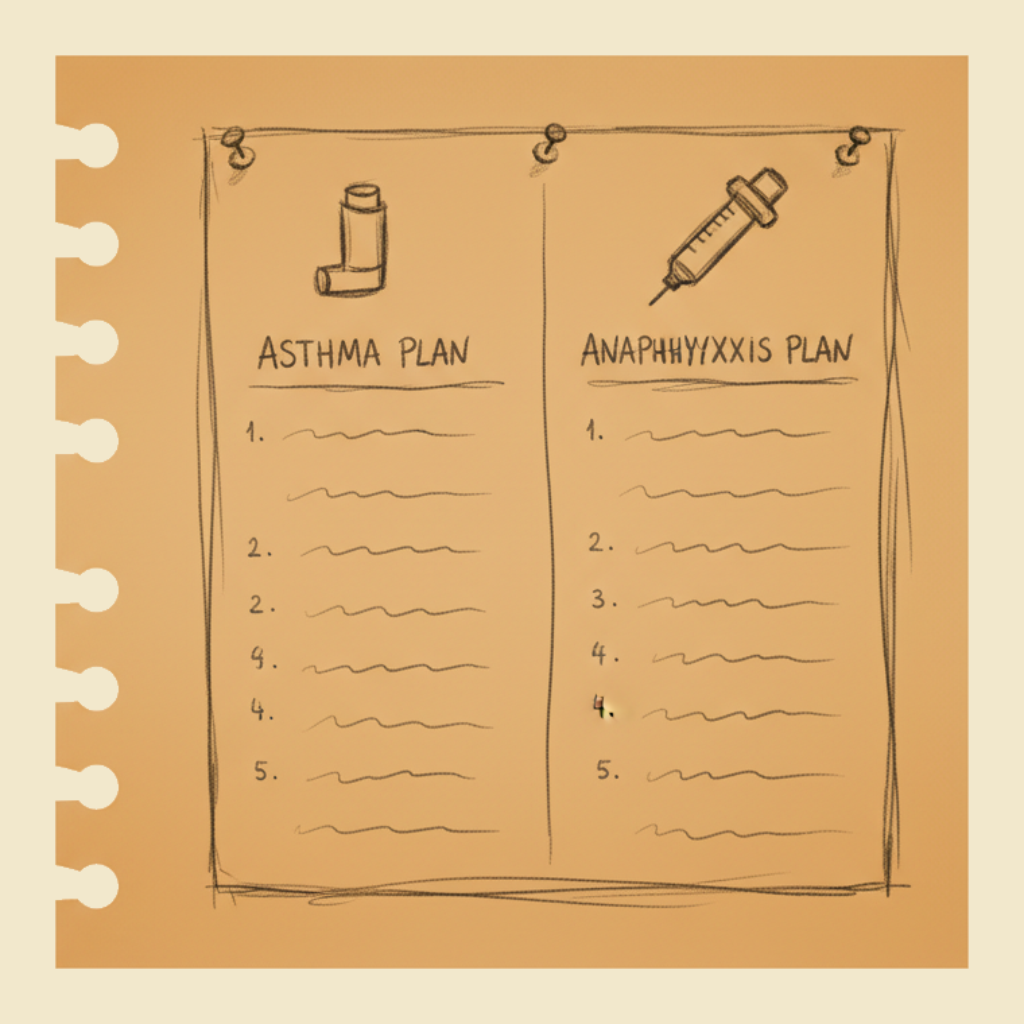
An emergency action plan is a written document, usually one page, that sets out the recognition signs and the response steps for a specific medical condition in a specific child. It is prepared by the child's doctor (sometimes with input from a specialist), provided to the parents, and held at the service so that any educator who is caring for the child can follow it when an event happens. G9.2.7 G9.2.5
The most common action plans you will see in an ECEC setting:
- ASCIA Anaphylaxis Action Plan — for children with diagnosed anaphylaxis. Produced by the Australasian Society of Clinical Immunology and Allergy (ASCIA), available in two versions: one for those with an EpiPen prescribed (red border) and one for those without (green border). Maps the signs of mild-moderate and severe allergic reaction to the response steps.
- ASCIA Allergic Reaction Action Plan — for children with allergies but not yet diagnosed with anaphylaxis. The "green" plan.
- Asthma action plan — produced by the child's doctor or by the National Asthma Council, sets out the child's usual symptoms, triggers, medications, and the response steps for an asthma flare.
- Diabetes management plan — for children with type 1 diabetes, sets out the routine management (blood glucose monitoring, insulin, food) and the response to hypoglycaemia and hyperglycaemia.
- Epilepsy or seizure action plan — for children with a seizure disorder, sets out the recognition of seizures, the response, the criteria for emergency action, and any rescue medication.
- Other condition-specific plans — adrenal insufficiency, cystic fibrosis, congenital heart disease, severe eczema, mast cell disorders, and many others. Each child with a chronic condition that may require an emergency response has, or should have, a plan.
The action plan is not a medical history or a general care plan. It is a decision tool for an emergency — what to look for, what to do, in what order, and when to escalate. The clarity is its strength: under the stress of a real event, the educator does not need to remember the protocol from a training day six months ago. They need to find the plan and follow the steps.
This chapter is about action plans as a category. The specific conditions have their own chapters: see the anaphylaxis chapter, the asthma chapter, the diabetes chapter, and the seizures chapter.
§ Instructor's note
The teaching point of this chapter is that action plans are not paperwork — they are operational tools, and the educator's job in advance of any event is to know which children have which plans, where the plans are stored, and what they say. The educator's job during an event is to fetch the plan and follow it, not to improvise from memory. Drill the rule: read the plans now, find the medications now, rehearse the response now — because the moment of the event is too late to start.
Why action plans exist
Action plans solve a specific problem in care of children with chronic conditions: the gap between a doctor's diagnosis and the moment when an emergency happens, in a place where the doctor is not. The doctor has assessed the child, knows the diagnosis, knows the appropriate response, and has prescribed the right medication. But the doctor is not at the service. The educator who finds the child in distress is not a doctor and may have no medical training beyond first aid. The action plan bridges this gap by translating the doctor's instructions into a form that any first aider can follow.
Without an action plan, the educator's options when a child has a flare of a chronic condition are:
- Call the parent and ask what to do — slow, often impractical, sometimes unreachable.
- Call 000 — appropriate but often more than the situation needs.
- Improvise — risky, especially when the child has a condition the educator does not know well.
- Delay — deadly, particularly for anaphylaxis and severe asthma.
With an action plan, the educator's options collapse into one: follow the plan. The plan has been written by the doctor, agreed with the parents, and adapted to the specific child. It is the right answer until proven otherwise.
What an action plan typically contains
Every action plan looks slightly different depending on the condition and the child, but most contain the following elements:
- The child's name and a recent photograph. The photograph is important — in a busy room with lots of children, the educator should be able to confirm at a glance that the plan they are holding belongs to the child in front of them.
- The date of the plan and a review date. Plans expire and should be updated regularly.
- The diagnosis. What condition the plan is for.
- The triggers. What is known to set off an event in this child (specific allergens, exercise, cold air, infection, hypoglycaemia, etc.).
- The recognition signs. What an event looks like in this specific child — both the typical pattern and any unusual presentations.
- The response steps. What to do, in order, with timings where they matter.
- The medications. What the child has at the service, where they are, the dose, the route of administration, and the storage requirements.
- The escalation criteria. When to call 000 and when to call the parent.
- The contact details. Parent, GP, specialist, and emergency contacts.
- The signature of the prescribing doctor.
A good action plan is short, clear, and visual — colour-coded, using symbols and bullet points rather than long paragraphs. The ASCIA anaphylaxis plan is a model of this style and is worth looking at as an example of how a plan should be designed.
Where action plans live in the service
Action plans should be:
- In the child's individual file — the master copy.
- With the child's medications — so that when an educator goes to fetch the EpiPen or the puffer, the plan is right there.
- Visible to all educators who care for the child — often displayed in the room, in a folder near the medication cupboard, or in a designated "medical alerts" location.
- Accessible immediately — not locked in an office that requires a key, not buried in a filing cabinet that takes minutes to search.
- Reviewed regularly — at least annually, or whenever the child's condition or treatment changes.
A common arrangement: a folder near the medication cupboard with all current action plans, organised by child name, with each plan stored alongside the relevant medications. A second copy in the child's individual file. The educators who care for the child review the plans at induction and at any update.
Some services display action plans on the wall near the child's room, with the photograph and the key information visible to any educator who walks past. This works well as long as it does not breach the child's privacy — see the privacy and confidentiality chapter for the considerations.
The educator's responsibility is to know where the plans are kept in their service, and to be able to find and read the plan for any of the children in their care within seconds. This is induction-level knowledge and should not depend on the supervisor being available.
Reading the plan in advance — before any event
The most important time to read an action plan is before the event happens. The educator who reads the plan for the first time during the emergency is at a serious disadvantage: they are processing unfamiliar information, in an unfamiliar layout, while a child needs immediate care. The educator who has read the plan in advance — in a quiet moment, perhaps at the start of the day or during nap time — has the structure already in their head.
The minimum the educator should know about each child with an action plan in their care:
- The diagnosis.
- The recognition signs as they typically appear in this child.
- The medications the child has at the service, and where they are stored.
- The first response step.
- When to call 000.
- When to call the parents.
This is enough to start the response correctly even before the plan is in your hand. The plan itself is then the reference for the details — the dose, the timing, the second steps, the post-event monitoring.
In a well-run service, this knowledge is part of the educator induction for any room with children who have chronic conditions, and is refreshed at staff meetings whenever the plans are updated. If your service does not have this practice, raise it with the nominated supervisor.
Following the plan during an event
When an event happens, the response is:
- Recognise that the child is having an event of the type the plan covers. (This is sometimes obvious and sometimes hard — see the recognition discussion in the relevant condition-specific chapter.)
- Call for help — another educator to assist, the nominated supervisor to be informed.
- Get the plan and the medications. Send another educator to fetch them if you can; if you are alone, fetch them yourself but stay close enough to the child to keep them safe.
- Read the plan — quickly. Confirm the photograph matches the child. Find the response steps for the situation you are seeing.
- Follow the steps in order. Do what the plan says. If the plan says to give a particular medication, give it. If the plan says to call 000, call. If the plan says to position the child in a certain way, position them.
- Note the time of each step. This is important for the medical team that takes over.
- Continue to monitor the child's response to the steps. Watch for improvement, watch for deterioration.
- Escalate if the plan tells you to or if the child is not responding as expected.
- Communicate with the parent.
- Document everything — the recognition, the steps taken, the timings, the response, the outcome.
The plan is the script. The educator's job is to follow the script. There is no scenario in which improvising "your own way" is better than following the plan that has been written by the child's doctor — except in the rare situation where the plan has clearly been overtaken by events (the medication has been used and is empty, the child has stopped breathing and CPR is needed, the situation has become an obvious emergency). In those situations, the basic first aid principles take over; the plan is then a supplement to the first aid response, not a substitute.
If a child has had an event before and has an action plan that says "give the EpiPen", do not delay giving the EpiPen because you want to consult someone else, or you are not sure if the situation is "really" anaphylaxis, or you would like the parent to confirm. The plan exists because the doctor has already considered all of this and has given clear instructions. The educator's job is to follow the plan, not to second-guess it. Hesitation in following an action plan has caused preventable deaths in Australian early childhood services. Trust the plan, follow the plan, and if you are wrong about whether the situation needed it, the consequences will be small. If you are right and you didn't follow it, the consequences can be irreversible.
When there is no action plan
A child may have an event of a type that an action plan would cover, but no action plan exists. This happens when:
- The child has not been formally diagnosed with the underlying condition. The first event of asthma, the first allergic reaction, the first seizure — there is no plan because there has been no prior episode.
- The diagnosis is recent and the plan has not yet been provided to the service.
- The plan has expired and a new one has not been received.
- The child is at the service for the first time and the parents have not yet brought the plan.
- The condition is one for which an action plan is unusual.
In any of these cases, the response is the standard first aid response for the condition based on the educator's training. For anaphylaxis, that is the standard anaphylaxis response — see the anaphylaxis chapter. For asthma, the standard asthma response — see the asthma chapter. For seizures, the standard seizure response — see the seizures chapter. The principles of first aid do not depend on having a plan; the plan is the customisation, not the foundation.
After the event, the service should:
- Communicate with the parents about what happened and recommend medical assessment.
- Encourage the parents to obtain an action plan from their doctor for any future events.
- Update the child's file with the new information.
- Review the service's medication and emergency response procedures to make sure the response was appropriate and to identify any improvements.
Plans and medications — the connection
An action plan is paper. The medication is what implements the plan. The two go together: a plan without medication is a script without props, and medication without a plan is a tool without instructions. The educator's job is to know about both.
The medications most commonly stored at services for action plan use:
- Adrenaline auto-injectors (EpiPen, Anapen) — for anaphylaxis. Stored at room temperature, in the child's labelled container, with the action plan. Note the expiry date.
- Asthma puffers and spacers — for asthma. Stored in a similarly accessible location. Spacers must be the right size for the child.
- Glucose products (glucose gel, juice, glucose tablets) — for hypoglycaemia in diabetic children. Stored where they can be reached quickly.
- Insulin and blood glucose monitors — for diabetic children. Storage and use depend on the management plan.
- Rescue medications for seizures (midazolam buccal, diazepam rectal) — used only by educators specifically trained and authorised, and only as directed by the action plan. Most ECEC services do not administer these and refer instead to the ambulance.
- Adrenal replacement medications — for children with adrenal insufficiency, who may need an emergency hydrocortisone injection during severe illness or stress. Educators caring for these children need specific training.
- Other condition-specific medications as required.
The educator's responsibilities for stored medications:
- Know where they are. Not in general — exactly where, in which cabinet, on which shelf.
- Know the expiry dates. Most medications expire and need to be replaced. The nominated supervisor or designated person tracks expiry dates and asks the parents to provide replacements before old ones run out.
- Know which child each medication belongs to. Medications are labelled and stored individually. Never give one child's medication to another child, except in a true emergency where the alternative is death (the EpiPen for an unrecognised anaphylactic).
- Know how to use the medication. Practise with trainer devices at face-to-face training. The technique should be in muscle memory.
- Document every administration. Time, dose, child, indication, response, and the educator's signature.
See also the education and care services national law chapter for the regulatory requirements around medication storage and administration.
Plans and the rest of the team
Action plans are not the property of one educator. The whole team that cares for a child with a plan needs to know:
- That the child has a plan.
- What condition the plan covers.
- Where the plan is stored.
- Where the medications are stored.
- The basic outline of the response.
When a new educator joins the team, the action plans are part of their induction. When an existing educator is rostered to a new room, the plans for that room are reviewed. When a child with a plan starts at the service, all educators who will care for them are briefed. This is the responsibility of the nominated supervisor and the room leader.
A common gap is when casual or relief educators care for a child with a plan without knowing about it. The service should have a procedure to brief casual staff on the children with action plans in any room they are working in, on the day. The brief can be quick — five minutes with the room leader at the start of the shift — and it makes the difference between a competent response and a paralysed one.
Some children have more than one action plan — for example, a child with both anaphylaxis and asthma, or a child with diabetes and a seizure disorder. The plans are stored together but cover different events, and the educator needs to know the recognition signs for each. The risk in a multi-plan child is misidentifying the event and applying the wrong plan — treating an asthma flare as an anaphylactic reaction, or vice versa. The plans help with this by listing the recognition signs specific to that condition in that child. When in doubt, follow the plan that fits the signs you are seeing, and call for help.
Plans and the new diagnosis
Some children develop a chronic condition during their time at the service. A child may have their first asthma attack, their first severe allergic reaction, their first seizure, or be newly diagnosed with diabetes. The service's response:
- Manage the immediate event with the standard first aid response for the condition.
- Communicate with the parents about what happened and the need for medical follow-up.
- Welcome the action plan when the parents bring it in. Some parents are anxious about the implications of a new diagnosis and need reassurance that the service can continue to care for the child.
- Brief the staff on the new plan and any new medications.
- Update the child's file with the new information.
- Review the service's procedures to make sure they support the new requirement.
A new diagnosis is not a reason to ask the family to leave the service. It is a reason to update the care arrangements and to make sure everyone is prepared. The Education and Care Services National Law explicitly supports the inclusion of children with chronic conditions, and the action plan is the mechanism that makes inclusion safe.
Children with diagnosed conditions that may require emergency intervention should have an individualised action plan, prepared by their treating doctor and held at every location where they receive care. The action plan should include the recognition of an event, the steps of the response, the medications to be administered, the criteria for emergency escalation, and the contact details for the family and the medical team. Educators caring for children with action plans should be familiar with the plans in advance and should follow them precisely during an event. Action plans should be reviewed regularly and updated as the child's condition or treatment changes.
What not to do
- Do not wait until an event happens to read the action plans. Read them in advance.
- Do not improvise during an event when the plan tells you what to do. Follow the plan.
- Do not delay administering a medication that the plan calls for. Hesitation is the enemy.
- Do not give one child's medication to another child, except in a true life-threatening emergency where it is the only option.
- Do not allow a plan to expire without a replacement. The nominated supervisor should be tracking this.
- Do not keep plans inaccessible — locked away, hidden in a folder, or in a location that takes minutes to find.
- Do not assume a casual or relief educator knows about the children's action plans. Brief them at the start of the shift.
- Do not treat the plan as the entire response when the child needs more — call 000 if the plan says to, or if the child is deteriorating.
- Do not consider the response complete until the documentation is done and the family is informed.
You will look at sample action plans for anaphylaxis, asthma, diabetes, and seizures, and discuss how to follow each one in a simulated event. You will practise the EpiPen technique on a trainer device, the puffer-and-spacer technique on a paediatric model, and the recognition of hypoglycaemia and seizure activity. You will also discuss the storage and labelling of medications and the documentation that accompanies each administration.
An action plan is the bridge between a child's diagnosis and the educator's response. It is written by the doctor, agreed with the family, and held at the service so that any educator can follow it when the moment arrives. Read the plans before any event, know where the medications are, follow the plan precisely when the event happens, and document the response. The plan is the script; the educator's job is to perform it well. The children whose plans are followed promptly are the children whose conditions stay manageable. The ones whose plans were not followed in time are the cautionary tales the rest of us learn from.
— ASCIA action plans and ANZCOR Guideline 9.2.7 (anaphylaxis)