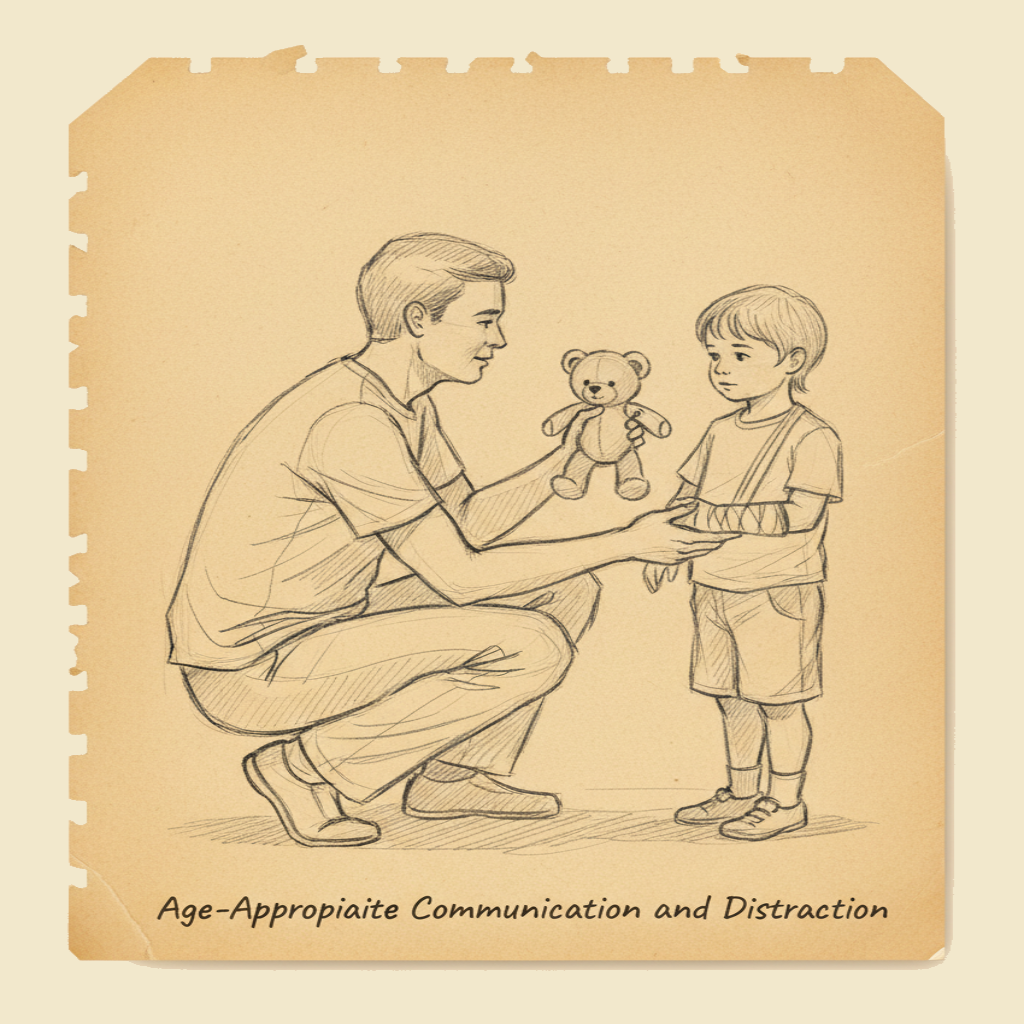
Why this is a chapter and not a footnote
Most adult first aid is delivered to a casualty who, even if frightened, can be reasoned with as an adult. They can be told what is happening, can ask questions in adult language, and can cooperate with the response in an adult way. Children are different. A frightened child may scream, fight, hide, freeze, or run. A young child cannot understand a long explanation. A toddler may lose all language under stress. A school-age child may understand the words but not the implications. The technical first aid skill — pressing a wound, applying a bandage, holding a cold pack, giving an EpiPen — is the same as for an adult, but the context in which the educator is trying to deliver it is harder. Communication and distraction are the skills that make the technical skills work in a paediatric setting. G10.5
This chapter is about those skills. The general communication framework, the distraction techniques, and the recognition of when a child has been overwhelmed are the same across most first aid scenarios; the specific things to say in particular situations are in the relevant condition-specific chapters.
§ Instructor's note
The teaching point of this chapter is that the educator's voice, manner, and presence are themselves first aid interventions, and they are not optional extras to the technical work. A child whose first aider is calm, kind, and clear recovers faster, cooperates more, and remembers the experience less traumatically than a child whose first aider is silent, brusque, or panicked. Drill the rule: get to the child's level, speak softly and slowly, tell them what is happening, ask before doing where you can, and use distraction to give the brain something else to focus on.
What a frightened child needs from an adult
When a child is hurt, sick, or scared, the things they need from the adult in front of them are:
- Safety — the immediate, animal sense that they are not in danger and that the adult is in control of the situation. This is conveyed by your tone, your body language, and your steadiness more than by your words.
- Familiarity — a known person, a known voice, a known smell, a known comfort item. The educator the child is closest to is usually the right one to manage the child if available.
- Information — what is happening, in language they can understand, with no surprises. Children are frightened by the unknown more than by the known.
- Predictability — what will happen next, when it will happen, and when it will be over. "I'm going to put a bandage on your knee and then we'll have a story together" is more reassuring than the silent application of a bandage.
- Choice where possible — small choices that give the child a sense of control. "Do you want to sit on my lap or in the chair?" is small, but it makes the child a participant rather than a victim.
- Honesty — including honesty about what might hurt or be uncomfortable. Children who are told "this won't hurt" and then it hurts are less likely to trust the next adult who tries to help them.
- Comfort — physical closeness, gentle touch, holding, the ordinary things a child would seek from a parent in distress.
- Patience — time to react, time to calm, time to cooperate. Rushing a frightened child usually makes the situation harder.
These are not in order of priority — they are all needed at once. The educator's job is to provide the package, even while delivering technical care.
Getting to the child's level
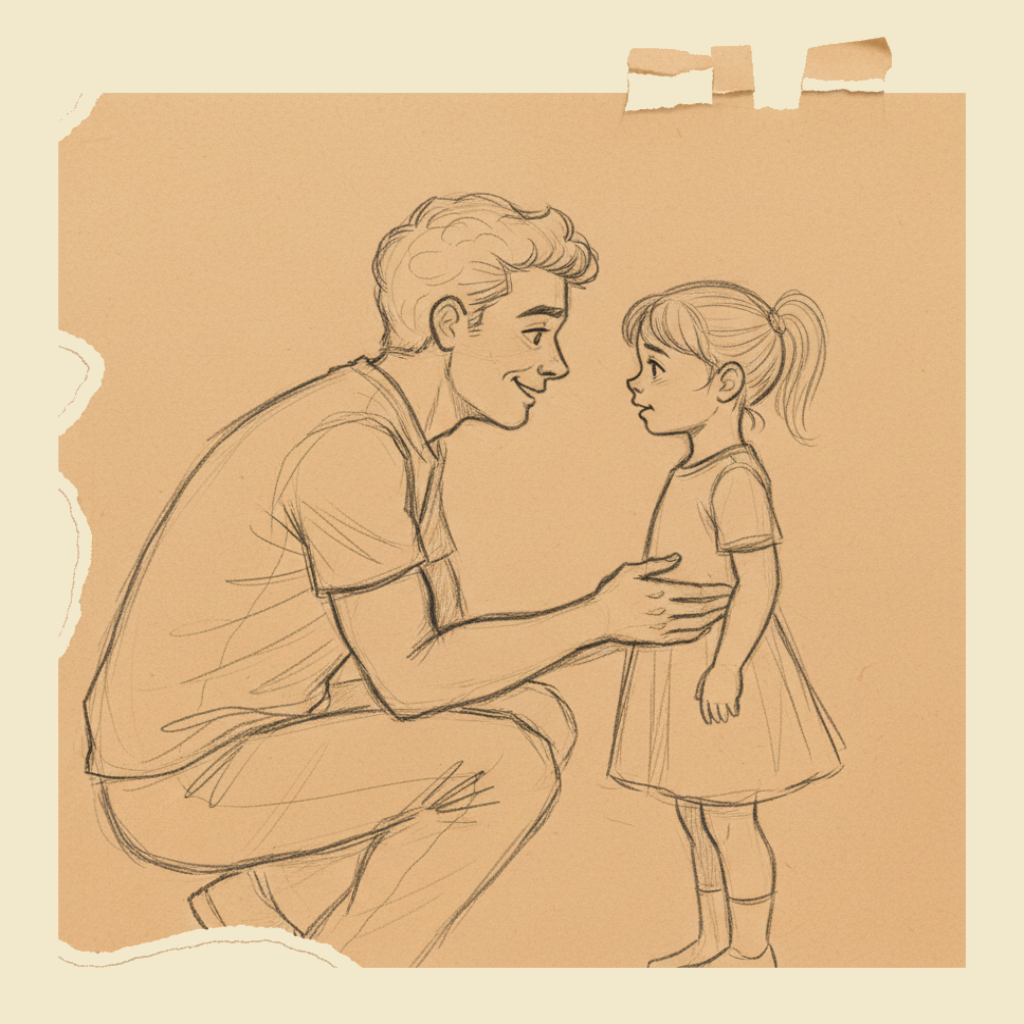
The single most important physical thing the educator can do is to get to the child's level. An adult standing over a small child is intimidating; an adult sitting on the floor next to the child is approachable. Squat down, sit on a low chair, or sit on the ground. Make eye contact at the child's eye level, not from above.
This is more important than it sounds. The change in physical posture changes the whole dynamic of the interaction. The child can see your face properly, can see your expression, can see that you are not towering. The educator's tone tends to soften when their body has softened. The child responds in kind.
A small additional point: do not stand in front of bright light (a window, a lamp) while talking to a child. Your face becomes a silhouette and the child cannot read your expression. Position yourself so the light is on your face, not behind you.
The voice — what calm sounds like
The educator's voice is one of the most important first aid tools. A calm voice transmits calm. A panicked voice transmits panic. The voice you want to use with a frightened child:
- Slower than your normal speed. Adult conversation is fast; children process more slowly, and a frightened child even more so. Slow down by perhaps half.
- Softer than your normal volume. Loud is intimidating. Quiet draws the child's attention rather than driving them away.
- Lower than your normal pitch. A high, anxious pitch sounds urgent and frightening. A lower, steady pitch sounds like an adult who has the situation in hand. (The instinct under stress is the opposite — voices rise — and it takes deliberate effort to lower yours.)
- Gentle in tone. Warmth, kindness, the way you would speak to someone you love. Children pick this up immediately.
- Steady. Pauses are fine, but the rhythm should be predictable. A voice that catches, stops, restarts, and trails off transmits anxiety.
Try to do this before you have to do it for real. Practise speaking to a child the way you want to be able to in an emergency. The neural pathways for "the calm voice" are easier to find when you have used them often.
Words that help
Some patterns that work in paediatric first aid:
Naming what is happening
"You hurt your knee when you fell. There's a small cut on it and it's bleeding. I'm going to clean it and put a special plaster on it. It might sting a little bit when I clean it, but I'll be quick. OK?"
This is telling the truth, in simple language, in advance. The child knows what happened, what is going to happen next, what to expect. Compare with the alternative — silent grabbing of the knee, application of antiseptic without warning, sting, child screams — and the difference is obvious.
Acknowledging the feeling
"That was a really sore bump, wasn't it? I bet it hurt a lot." This is not minimising and not catastrophising — it is matching the child's experience with words. The child feels heard. Once they feel heard, they can usually start to settle.
The opposite — "You're OK, you're not really hurt, stop crying" — invalidates the child's experience and usually makes them cry harder. Even when the injury is genuinely minor, the child's experience of it is real, and dismissing the experience does not help anyone.
Naming the body part
"I'm going to gently move your arm" is better than "I'm going to move you" — the specificity helps the child anticipate. For very young children, you can use the word for the body part the child uses ("your sore tummy", "your owie").
Asking permission where you can
"Can I look at your arm?" is better than "Show me your arm" — it gives the child a sense of being asked rather than commanded. Most of the time the child will say yes; when they say no, you can explore why ("It's OK, I won't hurt it, I just want to see if there's a cut") rather than fighting.
For things you must do whether the child agrees or not (giving an EpiPen to an anaphylactic child, for example), do not ask permission you cannot honour. Tell the child what you are going to do, calmly, and do it. Asking permission and then doing it anyway when they refuse damages trust.
Using simple, concrete language
"Press here" is better than "apply pressure". "Sit here" is better than "have a seat". "It will feel cold" is better than "the application of a cold compress". Children take adult language literally and do not have the vocabulary for medical phrasing. Strip the language down.
Avoiding scary words
Some words frighten children disproportionately and have alternatives that are no less accurate but less alarming:
- "Hospital" frightens many young children. "The doctor's house" or "the place where the doctors look after kids" can soften it.
- "Needle" frightens almost every child. For an injection or auto-injector, "a quick poke" or "a tiny press on your leg" works better in the moment.
- "Cut" frightens. "A little hole in your skin" or "a place where the skin opened up" is gentler.
- "Blood" frightens. Acknowledge it ("yes, there's a little bit of blood") but do not dramatise.
- "Broken" frightens. For a possible fracture, "your arm has a sore spot inside" is enough until the doctors are involved.
The point is not to lie or to hide the truth — it is to use words the child can absorb without panicking. The truth can be told in many ways, and the gentle way is the better choice for a child who is already overwhelmed.
Telling them what is going well
"You're being so brave." "You're doing a great job sitting still." "I can see you're a really good helper." Children respond strongly to genuine praise, and it gives them a positive identity to inhabit during a stressful situation. A child who has been told they are being brave will often act bravely in the next minute, even if the previous minute was tears.
Distraction — the second hand of paediatric first aid
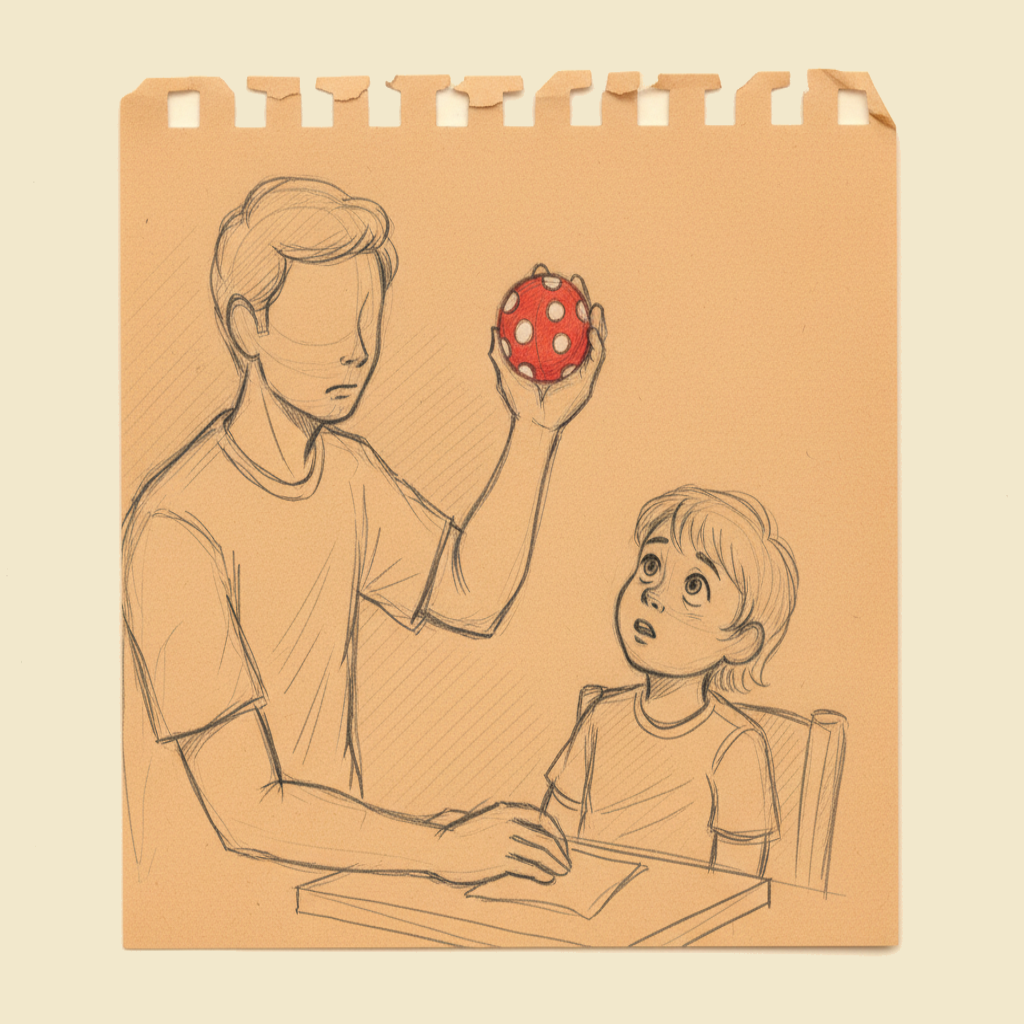
Distraction is one of the most evidence-supported pain interventions in paediatric care. The brain has limited attention, and giving it something else to focus on reduces the share that goes to the pain, the fear, or the procedure being done. Pediatric hospitals invest in distraction therapists for exactly this reason. The educator can do the same thing without the title.
What works as distraction depends on the age:
Infants
- Holding and rocking. Physical motion is calming.
- Soft singing or humming. The mother's voice is the original distraction; any familiar voice in song works.
- A familiar comfort item — a soft toy, a blanket, a dummy.
- Skin-to-skin contact if appropriate and possible.
- Sucking — a dummy, a finger (the baby's), a bottle of milk if appropriate.
Toddlers (1 to 3)
- A familiar adult holding them.
- Looking at a book together. A familiar book they love is best.
- Counting. "Let's count to 10 — one, two, three…" Many toddlers will count along.
- Singing simple songs. Wheels on the Bus, Twinkle Twinkle, anything they know.
- Talking about something completely unrelated — "Did you have peas at lunch?" "What's your puppy's name?"
- A new and interesting object — a coloured pen, a sticker, a small toy from your pocket.
- Bubbles — if you have a bubble bottle to hand. Bubbles are almost magical for distracting young children.
Preschoolers (3 to 5)
- Storytelling. A short story, made up on the spot or from memory.
- Asking them to help — "Can you hold this for me?" "Can you count how many bandaids I'm using?"
- Asking them to choose — "Do you want a blue plaster or a green one?"
- I-spy. "I spy with my little eye, something… blue."
- Talking about their favourite things — "Tell me about your favourite cartoon."
- Breathing exercises — "Let's blow out a pretend birthday candle. Big breath in, blow it out slowly. Now another one."
- Tablets or phones with a child-friendly video, if your service allows screens for this purpose.
School-age (5 to 12)
- Conversation — about school, friends, hobbies, recent events, anything.
- Asking them to describe what they are seeing — "Tell me about the picture on that wall."
- Counting backwards from 100 — engaging for older children.
- Word games — "Name a country starting with B." "Name an animal starting with P."
- Breathing exercises with a structured count — "In for four, hold for four, out for four."
- Letting them watch what you are doing if they want to (some children find it less scary if they can see what is happening) or look away if they don't.
- Talking about what will happen after — "When the doctor has fixed your arm, we'll go and tell your mum, and she'll come and pick you up."
The choice depends on the child and the situation. Try one thing; if it doesn't work, try another. The goal is not to make the child laugh — it is to occupy their attention enough that the pain or the fear is reduced.
Honesty — and the limits of distraction
A note of caution: distraction works best when the child is not actively being lied to. If you tell a child "this won't hurt at all" and then it hurts, the next time the child encounters first aid they will have learned that adults lie to them about what hurts, and the techniques will work less well.
Honest preparation is better:
- "This will sting for a few seconds and then it will feel better." Specific, honest, manageable.
- "You might not like the cold, but it will help your bump go down." Names the discomfort, names the benefit.
- "This will be over in a count of three." Gives a clear endpoint.
The combination of honest preparation with active distraction is more effective than either alone. The child knows what to expect, and their attention is partially elsewhere while it happens.
Communicating with infants and pre-verbal children
Infants and very young toddlers do not understand the words, but they understand the prosody — the rhythm, melody, and tone of speech. They also understand body language, facial expression, and physical handling. The educator's communication with a pre-verbal child is mostly:
- Tone of voice — soft, warm, slow.
- Facial expression — calm, interested, smiling where appropriate.
- Physical touch — gentle, predictable, warm. Avoid sudden movements.
- Eye contact — meeting the baby's gaze without staring.
- Singing or humming — particularly during a stressful moment.
- Holding and containing — wrapping the baby in a blanket, holding their limbs gently against their body, providing the boundaries that make them feel held.
Talk to the baby anyway, even though they cannot understand the words. The act of talking conveys calm, and your own voice helps you stay calm too. The narration is for both of you.
When the child is uncooperative
Some children will not cooperate, no matter how skilfully you communicate. They scream, fight, run, hide, kick, bite, or freeze. The educator's response:
- Do not force the issue if you can avoid it. Forcing first aid on a struggling child usually makes the situation worse — the child is more frightened, the educator is more stressed, the technical work is harder, and the child's memory of the event is more traumatic. Pause if you safely can, settle, try again.
- Get help. Another educator can hold a child, or distract a child, while the first one provides care. A child who needs to be held still for an essential treatment needs at least two adults — one for comfort and containment, one for the technical work.
- Use the parent if available. A parent who is on the way can sometimes be on the phone, calming the child while the educator works. A parent who is present can hold the child while the educator does the technical work.
- Explain to the child what you must do even if you must do it without their cooperation. Honesty about what is happening is still better than silent imposition.
- For a true emergency, do what is necessary regardless of cooperation. A child in anaphylaxis needs the EpiPen even if they are fighting; a child in cardiac arrest needs CPR even if they would say no. The duty of care is unambiguous.
- Debrief after the event. A child who has had to be held for treatment may need extra reassurance, comfort, and explanation afterwards. Their memory of the event is what they will carry, and the educator's job includes shaping that memory toward "the adults helped me" rather than "the adults attacked me".
The child who fights you is not a bad child. They are a frightened child with limited tools. The educator's calm and the educator's persistence are what get through.
The instinct to comfort by saying "it won't hurt" is well-intentioned and counterproductive. Children remember the betrayal — and the broken trust spills over into every subsequent first aid encounter, with you and with other adults. Tell the truth: "This will sting a little for a few seconds, and then it will feel better." That sentence preserves trust, gives the child something to brace for, and lets them celebrate when it is over. Honesty is a comfort technique, not its opposite.
Communicating with the other children in the room
When one child is being given first aid, the other children in the room are watching and reacting. The educator needs to manage them too:
- A second educator should take responsibility for the rest of the group, if at all possible. The first educator focuses on the casualty; the second focuses on the audience.
- Explain what is happening, simply and honestly. "Sam fell over and hurt his knee. We're putting a bandaid on it. He'll be OK in a few minutes." Children make up much scarier stories in the absence of information than they do when given the truth.
- Move the other children away if the situation is serious or distressing.
- Resume the routine of the day as much as possible. Children are reassured by normality.
- Allow questions as they come. Children may want to know what happened, why, whether the casualty will be all right.
- Watch for the children who are particularly affected — quiet, withdrawn, clingy, tearful. They may need extra attention. See the rescuer and child stress support chapter.
The communication with the other children is not a distraction from the first aid — it is part of looking after the room.
Communicating with the parents
When the parents arrive (or are on the phone), the educator's communication shifts again. The parents are adults, they want detail, they want honesty, and they want to know what to do next. The conversation:
- Lead with the present state of the child — "Lily is awake and being looked after, she's settled in the quiet room with me."
- Describe what happened — when, what you saw, what you did, how it has progressed.
- Be honest about the level of concern — "We're worried about her" or "She's settled now and we're not too concerned, but we want her to be seen by a doctor today."
- Make a clear request — what you want the parent to do.
- Allow questions and answer them as fully as you can.
- Be specific about follow-up — when the next contact will be, who will call whom.
The parent's emotional response is part of the conversation. They may be calm; they may be frightened; they may be angry; they may be tearful. Acknowledge whatever is in front of you without trying to fix it. "I can see this is really worrying for you. She's safe now, and we're going to look after her until you get here."
See the parental consent chapter for more on the parent communication, and the referral and ambulance response chapter for the structured handover format.
Some children have communication challenges — speech delay, autism, hearing impairment, English as an additional language, intellectual disability. The communication techniques in this chapter apply to all children, but for some children the standard approach needs adaptation. The parents and any therapy team are the source of information about how to communicate with a particular child — what words they understand, what sensory input they tolerate, what comforts them, what frightens them. The child's individual file should include any communication notes. Read them in advance and use them in an event.
Psychological first aid is the supportive, calming, non-intrusive presence of a trained adult during and after a distressing event. It is built on the principles of safety, calm, connectedness, self-efficacy, and hope. For children, psychological first aid includes communication that is age-appropriate and honest, physical comfort from a familiar adult, distraction techniques that engage the child's attention, predictable explanations of what is happening, and patient acknowledgment of the child's emotional response. The first aider's calm, kind, and confident manner is itself a therapeutic intervention.
What not to do
- Do not stand over a child while talking to them. Get to their level.
- Do not speak in your normal adult fast voice. Slow down.
- Do not lie about whether something will hurt. Be honest, briefly.
- Do not ignore the child's feelings. Acknowledge them.
- Do not force a child to cooperate when you can wait, calm, and try again. Use force only when the situation requires it.
- Do not speak about the child as if they are not there. They hear you.
- Do not use scary medical words when plain words will do.
- Do not forget the other children in the room. They are watching.
- Do not forget to communicate with the parents at the right moment. The conversation is part of the care.
You will rehearse paediatric communication in role-play scenarios — talking to a frightened toddler with a bumped head, calming a school-age child with a stinging cut, distracting a preschooler during a bandage application, and communicating with a child whose parent is on the way. You will practise the calm voice, the level posture, the honest preparation, and the distraction techniques appropriate to each age. The technical first aid is the same in all of these; the communication is what makes it work.
Communication and distraction are not the soft side of paediatric first aid. They are the side that determines whether the technical first aid actually gets delivered to the child. Get to the child's level, speak softly and slowly, tell the truth in gentle words, acknowledge the feelings, give the child something else to focus on, and stay with them until someone they trust takes over. The child whose first aider was kind and clear is the child who recovers faster, fights less, and remembers the event without trauma. The voice and the touch are first aid interventions in their own right, and they cost nothing but practice.
— ANZCOR Guideline 10.5 (psychological first aid)