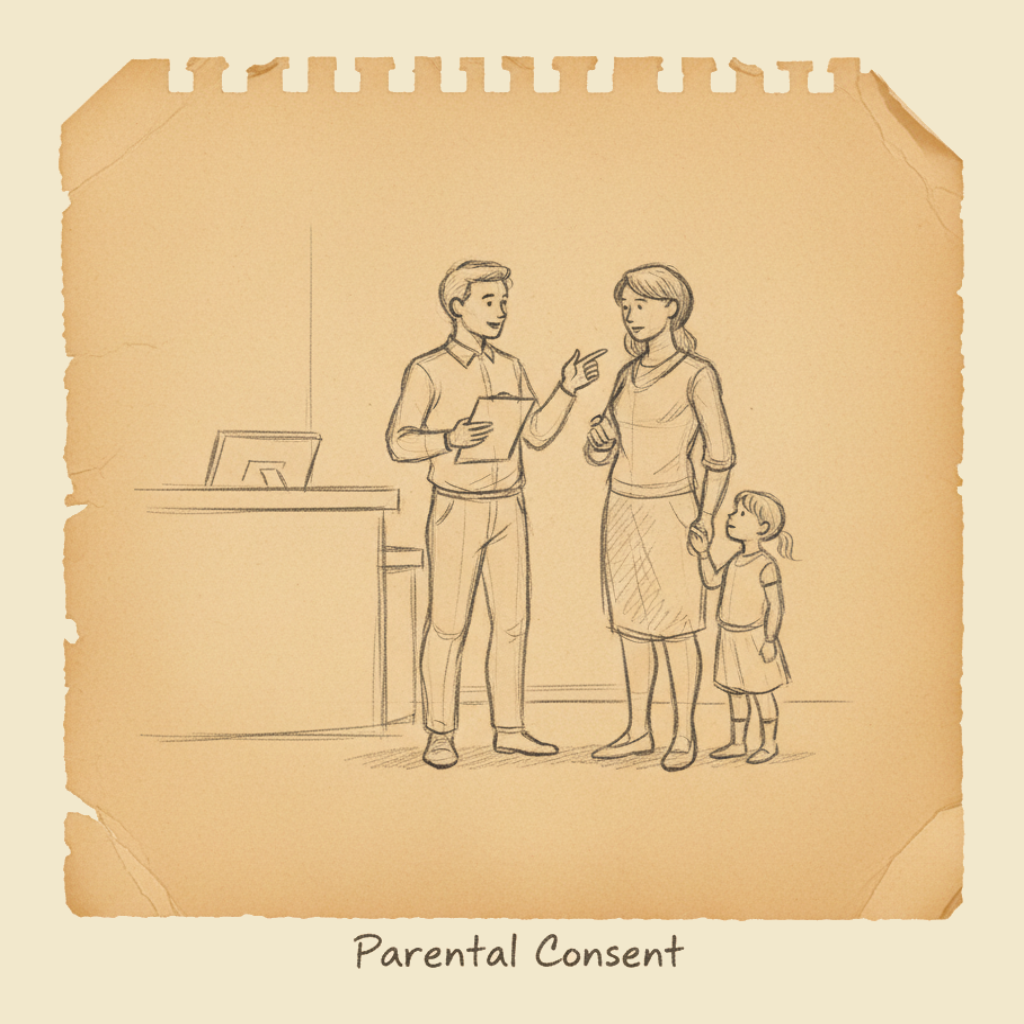
Why consent is its own chapter in ECEC first aid
Most adult first aid happens between strangers. Someone collapses in a shopping centre, a passer-by responds, the law of implied consent covers the response: a reasonable person in the casualty's situation would obviously want to be helped, the responder acts in their best interests, the legal foundation is straightforward.
First aid in an education and care service is different. The child is not a stranger. The service has a contract with the parent — the enrolment agreement — and that contract includes specific consents about what may be done for the child, by whom, and in what circumstances. The consent is not implied; it is written, specific, and on file. At the same time, in a true life-threatening emergency, the consent question disappears: the educator acts, fast, and the legal protection comes from the duty to preserve life rather than from any signed form.
This chapter is about that two-layer arrangement: what the parent has signed up to in the enrolment paperwork, and what the educator does when the situation has moved past what any form contemplated. The broader duty-of-care principles are in the duty of care chapter, and the law that requires the consent paperwork in the first place is in the education and care services national law chapter.
§ Instructor's note
The teaching point here is the layered structure of consent in an ECEC setting: there is enrolment-level consent (broad, signed once, covers the day-to-day), there is event-specific consent (a phone call to the parent for a non-emergency incident), and there is the emergency override (no consent needed when life is threatened). Educators get into trouble when they apply the wrong layer to the wrong situation — refusing to treat a serious casualty because they "couldn't reach the parent", or, conversely, going outside the enrolment consent in a non-emergency to do something the parent specifically did not want. Drill the rule: follow the enrolment consent for routine incidents, contact the parent for anything novel, and act immediately in any life-threatening emergency.
What the enrolment agreement covers

When a parent enrols a child at an approved education and care service, they sign an enrolment form that, among other things, captures the following consent and information:
- Consent for first aid to be provided in the event of injury, illness, or emergency at the service. This is the foundational consent the educator relies on for routine first aid.
- Consent for the service to seek emergency medical or ambulance attention for the child if the educator judges it necessary. This is what allows the service to call an ambulance without first reaching the parent.
- Authorisation for specific medications to be administered, where the child has a known condition (asthma, anaphylaxis, diabetes, epilepsy, etc.). This is paired with a medication authorisation form and, for prescription medications, the doctor's instructions.
- Authorisation for the application of sunscreen, the changing of nappies and clothing, the provision of food and drink consistent with the child's diet.
- Emergency contact details for the parent and at least one other authorised person who can be called if the parent is unreachable.
- Authorised collection list — the people the service may release the child to at the end of the day, or in an emergency.
- Health information — known allergies, medical conditions, dietary requirements, current medications, the child's GP, and any health-related instructions.
- Action plans for any condition that has one (asthma plan, anaphylaxis ASCIA Action Plan, diabetes management plan, seizure plan).
- Acknowledgement of the service's policies — the parent confirms they have been given access to the policies and understand them.
This is a substantial document, and it is the legal foundation on which the educator acts. Any first aid you provide that falls within the scope of the enrolment consent and the action plans is expressly authorised by the parent. You are not making it up; you are doing what they signed for.
The first aid that the enrolment consent covers
The everyday first aid that happens at a service — wiping a grazed knee, applying a bandaid, holding a cold pack on a bumped head, helping a child use their own asthma puffer in line with their action plan, comforting a child who has fallen — is all covered by the enrolment consent. The educator does not need to phone the parent before applying a bandaid. The consent is on file; the action is within the scope of normal care.
The threshold at which a phone call to the parent becomes appropriate is not legal but practical and relational: parents reasonably expect to be told when their child has been hurt, has been unwell, has had an unusual incident, or has had any first aid that goes beyond a bandaid. Most services have a written rule of thumb (something like "any incident above a minor scrape is communicated to the parent at pickup; anything more significant prompts a phone call sooner") and the rule of thumb is in the service's incident policy. Follow it.
The phone call is not a request for permission; the consent for the first aid is already on file. The phone call is information: this happened, this is what we did, this is how the child is now, and here is what we suggest you watch for. The parent's role on the phone is to be informed, to make any decisions about pickup or further medical attention, and to advise the service of anything they need to know about the child's specific circumstances.
When the parent's specific authorisation is needed
There are first-aid-adjacent situations where the enrolment consent is not enough on its own and the parent's specific authorisation is required in addition:
- Medication administration. The educator may only administer a medication that has been authorised on the medication form, by the parent, in line with the child's prescription. A different child's medication, an over-the-counter medication that has not been authorised, a medication for an unrelated complaint — none of these can be given without specific authorisation.
- Variation from an action plan. If a child has an asthma action plan and the educator follows the plan exactly, the consent is on file. If the educator believes the plan should be modified because the situation has changed, that is a conversation with the parent and ideally the doctor — not a unilateral decision by the educator.
- Transport to medical attention that is not an emergency. If the educator wants to take a child to the doctor because the educator thinks something is not quite right but it isn't an emergency, the parent decides — they may want to come and collect the child, take them to their own GP, or authorise the service to make an appointment.
- Procedures the parent has specifically declined. Some parents have requested that their child not have certain things done — for example, no medication of any kind without a phone call first, no sunscreen because of a sensitivity, no participation in certain activities. These requests are recorded on the enrolment form and on the child's file, and they bind the educator unless the situation rises to a true emergency.
The rule of thumb is: the enrolment consent covers the routine, the action plans cover the known conditions, and anything that falls outside both needs a phone call.
The emergency override
In a true emergency — a child not breathing, in cardiac arrest, in anaphylaxis, severely bleeding, having a prolonged seizure, drowning, or in any other immediately life-threatening situation — the educator acts first and contacts the parent afterwards. There is no question of waiting for the parent's authorisation to begin CPR, give an EpiPen, call an ambulance, or take any other immediately necessary step.
The legal foundation for this is several layers thick:
- The enrolment consent itself usually authorises emergency medical or ambulance attention without further reference to the parent. Most enrolment forms are explicit about this.
- The educator's duty of care to the child requires immediate action when the child's life is threatened. Failing to act because no one had given permission would be a breach of duty, not an abundance of caution.
- The Education and Care Services National Law requires services to manage the safety, health and wellbeing of children, and the relevant Regulations and policies require the educator to provide first aid in an emergency.
- The legal doctrine of necessity / emergency doctrine would, in any case, protect a reasonable rescuer who acted in good faith in a genuine emergency to preserve the child's life.
The educator's job in an emergency is not to debate the legal layers; it is to act. The recognition of an emergency is the cue to start the response, not to start a search for the consent form. Once the immediate response is underway and the child is being managed (CPR in progress, EpiPen given, ambulance called), then someone — usually a second educator or the nominated supervisor — contacts the parent.
If you ever find yourself thinking "I'm not sure I'm allowed to do this without the parent's say-so" while a child is in front of you not breathing, having anaphylaxis, severely bleeding, or otherwise in immediate danger — act. The consent is not the question. The duty of care, the enrolment authorisation, the National Law, and the doctrine of necessity all converge on the same answer: you provide the first aid the situation requires. The parent will be told as soon as the child is safe. There is no scenario in which a service or an educator has been penalised for providing prompt life-saving care to a child in a real emergency.
When the parent cannot be reached

A frequent and uncomfortable scenario: the child needs more than routine attention, the situation is not a life-threatening emergency, and the educator cannot reach the parent. The phone goes to voicemail; the workplace number is not picked up; the alternative emergency contacts are also unreachable.
The right approach is:
- Try the contacts in order, including the secondary emergency contact and the workplace number. Don't give up after one attempt.
- Keep trying while continuing to provide whatever first aid is appropriate. The first aid does not stop because the phone is going to voicemail.
- Consider whether the situation has crossed into an emergency. A child who initially seemed mildly unwell but is now getting worse may have crossed the line. If yes — call the ambulance, give the appropriate first aid, and keep trying the parent in parallel.
- Ask the nominated supervisor to take over the parent contact while you focus on the child. This is part of the supervisor's job and the supervisor may have access to additional contacts, employer phone lists, or other ways of reaching the family.
- If the situation is borderline and you cannot make a decision — call 000 anyway. The ambulance call is itself a decision-aid: the operator can advise on whether the situation warrants ambulance attendance, and if it does, the call has been made and the child will be assessed.
- Document every attempt to contact the parent, including the time and the result, in the incident record. The record is the evidence that the service acted reasonably in the absence of parental contact.
The wrong approach is to wait passively for the parent to call back. The educator has a duty of care that does not pause because the phone is unanswered. Acting in the child's best interests, in the absence of parental contact, is both legally protected and operationally necessary.
Consent and the older child's own views
In an ECEC setting the children are by definition young — typically infants to 5 or 6 years old in long day care, or up to 12 in outside-school-hours care — and the parent is the consent-giver. The child's own consent is not a legal requirement.
But the child's cooperation matters operationally, and the older a child gets, the more their views deserve to be respected within the limits of what their safety requires:
- A child who refuses first aid that is necessary for their safety should still receive it, but with as much explanation, gentleness, and reassurance as possible. Forcing first aid on a frightened child is a failure of communication, not a sensible default.
- A child who wants their parent before being treated can usually have the parent contacted by phone while the first aid proceeds. Hearing the parent's voice on the phone often calms a child enough to allow treatment.
- A child who refuses to take their own medication (their asthma puffer, for example) is a different problem and one to escalate immediately — both because the medication may be needed and because the refusal itself may be a sign that the child is more unwell than they look.
- A child whose own behaviour endangers them (running away, kicking, biting, refusing to stay still) is a child whose safety still has to be ensured. The educator's job is to manage the situation safely, with help from a second educator if needed.
The legal consent is the parent's, but the practical consent is the child's, and the more you can earn the practical consent the more the legal layer becomes a formality. See the communication and distraction chapter for the techniques that help.
Refusal of treatment by a parent
A separate, and difficult, situation: a parent who arrives at the service and refuses treatment that the educator believes the child needs. This can happen at pickup when the parent disagrees with the educator's assessment that the child should see a doctor, or it can happen on the phone when the parent says "no, don't call an ambulance, I'm coming to get them".
The principles are:
- The parent has the right to make decisions about their child's care. The service is not the parent and cannot override a parent's decision in non-emergency situations.
- The educator's duty of care continues until the child is collected. Until the parent has the child, the service is responsible.
- In a genuine emergency, the educator's duty of care overrides parental refusal. A parent who tells you on the phone not to call an ambulance for a child who is not breathing is not making a decision the educator is obliged to follow. Call the ambulance, give the first aid, and let the legal questions sort themselves out afterwards.
- In a non-emergency disagreement, document the parent's instructions, the educator's recommendations, and the outcome. The record protects both the service and the child.
- Escalate to the nominated supervisor for any significant disagreement. This is not the front-line educator's call to make alone.
- If the situation involves a child safety concern — a parent whose refusal seems to put the child at risk of harm — that is a child protection matter and may trigger a mandatory report under state child protection law. See the education and care state regulations chapter for the local arrangements.
Many children at the service have parents in separated households, with shared care, custody orders, or other family-law arrangements. The enrolment form should record which adults have legal authority to make decisions about the child, who is on the authorised collection list, and any restrictions (a non-custodial parent who must not collect the child, for example). The educator's job is to follow the enrolment paperwork, not to make judgments about the family. If a situation arises that the paperwork does not cover — an unfamiliar adult turning up to collect, a phone call from someone the educator doesn't recognise — escalate to the nominated supervisor before acting.
After the incident — the conversation with the parent
When the incident is over and the parent is on the phone or at pickup, the educator's communication should be:
- Calm and factual — what happened, what was done, how the child is now.
- Honest — including any uncertainty about what caused the incident or what the educator could have done differently. False reassurance erodes trust.
- Specific — name the time, the activity, the casualty, the response. Vague accounts make parents anxious.
- Forward-looking — what the educator suggests the parent watch for, when to seek further medical attention, when to expect a follow-up.
- Documented — the conversation itself, and its outcome, goes into the incident record.
The conversation is also where the parent is given any written documentation the service produces — a copy of the incident report, an asthma plan that has been updated, a referral note. The service's communication protocol will set out what is shared and how.
The first aider's role in the conversation is usually the technical part — what happened and what was done — while the nominated supervisor or director may handle the broader context and any questions about what the service will do next. See the privacy and confidentiality chapter for the privacy considerations and the workplace procedures chapter for the documentation.
First aid for children in education and care settings is provided on the basis of the consent given by the parent or guardian at the time of enrolment. In a life-threatening emergency, first aid should be commenced immediately without waiting for additional consent, and the parent or guardian should be contacted as soon as practicable thereafter. The first aider should follow the service's written policies, the child's individual action plans where applicable, and the instructions of any qualified medical personnel who become involved.
What not to do
- Do not delay life-saving first aid because you cannot reach the parent. Act first.
- Do not administer a medication that has not been authorised for the child on the medication form, except in a true emergency where the medication is needed to save life (an EpiPen for anaphylaxis being the clearest example).
- Do not treat the enrolment consent as a blank cheque. It covers routine first aid and emergency response; novel or borderline interventions are a phone call to the parent.
- Do not debate consent with a parent in the middle of a serious incident. Act in the child's best interests and document the events for review afterwards.
- Do not release the child to anyone who is not on the authorised collection list, even in an emergency, without specific authorisation from the parent or the nominated supervisor.
- Do not keep a serious incident from the parent. Honest, prompt communication is both an ethical and a regulatory obligation.
- Do not make consent decisions alone in difficult situations. The nominated supervisor is there for exactly this kind of escalation.
You will rehearse the parent communication in role-play scenarios — calling a parent to report a fall, calling about an asthma attack that has resolved, calling about an anaphylaxis where the ambulance is on the way. You will also practise the awkward middle-ground situation where the parent cannot be reached and the situation is borderline. The technical first aid is the easier part; the parent conversation is the part that makes the difference to the family's experience and to the service's relationship with them.
The parent's consent is the foundation on which routine first aid for a child at an ECEC service rests, and the enrolment paperwork captures it once and lets the educator act on it every day. The phone call to the parent is information, not a request for permission. And in a real emergency the consent question disappears altogether — the educator acts to preserve life, the parent is told as soon as the child is safe, and the duty of care is the only legal layer that matters in the moment.
— Education and Care Services National Law and ANZCOR Guideline 10.1