Why the state layer matters
The Education and Care Services National Law is, as the name suggests, national — the same words appear in the legislation of every participating Australian state and territory, and the National Quality Framework (NQF) it sits inside is meant to produce the same outcome wherever you work. But the system that enforces the Law is not national. It is run by a Regulatory Authority in each state or territory, each Authority sits inside a different department of state government, and each adds its own jurisdictional detail to the way the Law operates on the ground.
For a first aider working in an education and care service, the practical implications are usually small — your service's policies translate the rules into action, and the rules are mostly the same everywhere — but it pays to know who your Regulatory Authority is, what they expect, and where the state-specific layer changes things. This chapter is the orientation. The detail of what the Law itself requires is in the education and care services national law chapter.
§ Instructor's note
The teaching point here is the architecture, not the line-by-line content. Educators do not need to memorise their state's regulations — that is what the service's nominated supervisor is for — but they do need to know that there is a Regulatory Authority specific to their jurisdiction, that the Authority sets reporting timeframes and conducts the assessments, and that any state-specific guidance comes from that Authority. Drill the rule: your state has a Regulatory Authority; your service knows who it is; if you need state-specific guidance you ask your nominated supervisor or look at the Regulatory Authority's website.
How the system fits together
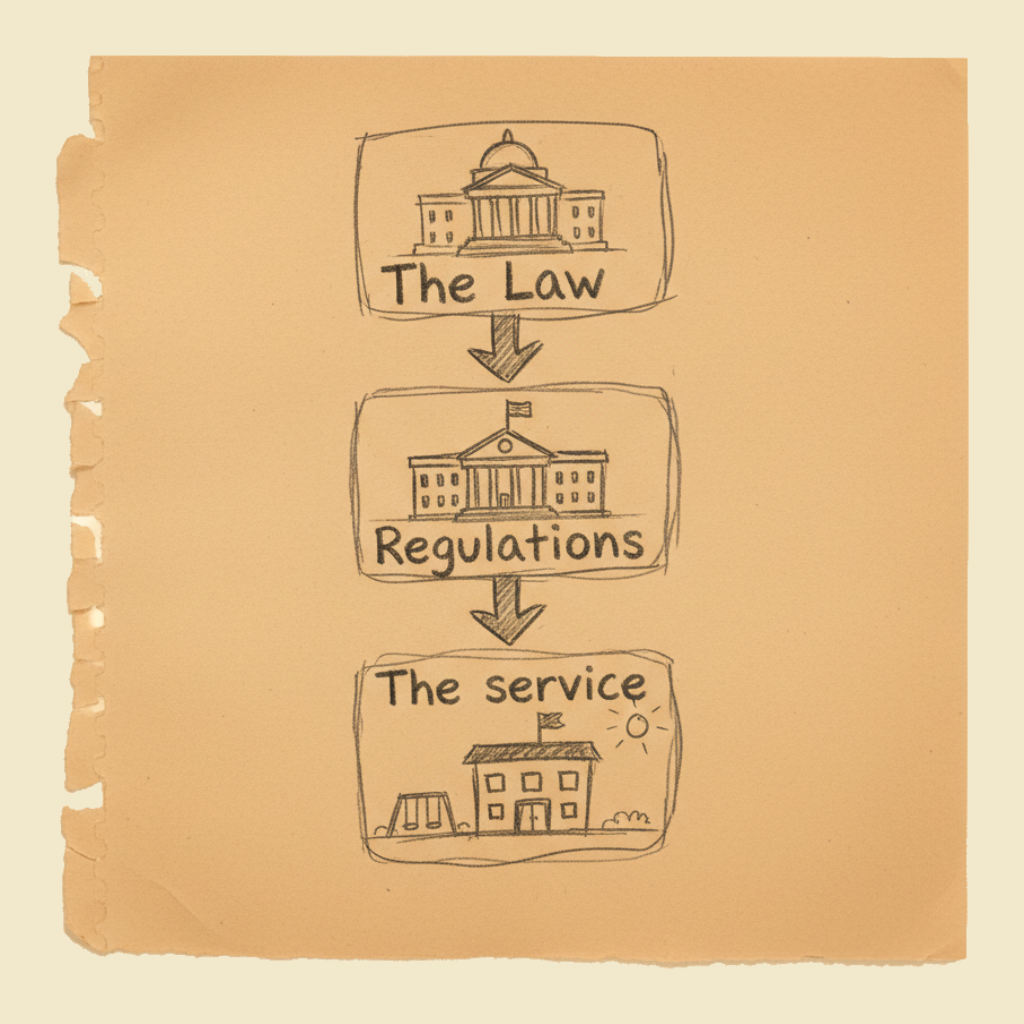
The structure has four levels, and it is worth being clear about each:
- The Education and Care Services National Law — a single piece of legislation, applied uniformly in every participating jurisdiction. This is the primary law.
- The Education and Care Services National Regulations — the detailed rules made under the National Law, also national. This is where you find the ratios, the qualification requirements, the medication procedures, the incident notification rules.
- The state or territory administering legislation — a small Act of state Parliament that adopts the National Law in that jurisdiction and sets up the local Regulatory Authority. This is where state-specific administrative provisions live (penalties, appeal mechanisms, the identity of the Regulatory Authority).
- State-issued operational guidance — circulars, fact sheets, sector communications and policy templates that the Regulatory Authority publishes to help services interpret the Law in the local context.
Underneath all of that sits the service's own policies and procedures, which are written to comply with the above and which are the documents you actually consult day-to-day.
The result is a system in which the rules are the same in Sydney, Brisbane, Hobart and Darwin, but the Regulatory Authority you call when you need to make a notification, and the specific templates you use, are local to your state.
The Regulatory Authorities
Each state and territory has nominated a department or agency as its Regulatory Authority. These change name from time to time as governments restructure their bureaucracies, so the safest approach is to check your service's policy folder or the ACECQA website for the current names — but the broad picture is:
- New South Wales — the Department of Education (NSW Early Childhood Education Directorate). NSW services interact with the NSW ECE Directorate for approvals, assessments, and serious incident notifications.
- Victoria — the Department of Education, through its Quality Assessment and Regulation Division. Victoria has historically been one of the more active Regulatory Authorities and publishes detailed guidance for services.
- Queensland — the Department of Education, Early Childhood and Education and Care Regulation. Queensland operates a regional structure with regulatory officers across the state.
- South Australia — the Education Standards Board (an independent statutory authority), which sits at arm's length from the Department for Education.
- Western Australia — the Department of Communities. WA is the one jurisdiction that operates under its own state legislation rather than the National Law as adopted elsewhere, but the substance of the rules is the same and ACECQA still administers the National Quality Standard for WA services.
- Tasmania — the Department for Education, Children and Young People (Education and Care Unit).
- Australian Capital Territory — the Children's Education and Care Assurance unit, sitting inside the ACT Government's Education Directorate.
- Northern Territory — Quality Education and Care NT, inside the Department of Education and Training.
The names will drift; the function is constant. Each Authority does the same set of things: grants service approvals, assesses and rates services against the National Quality Standard, investigates complaints, receives notifications of serious incidents, and takes enforcement action when the Law is breached.
The Western Australian arrangement
Western Australia is the one quirk in the system. Rather than enacting the National Law as adopted in the eastern states, WA passed its own Education and Care Services National Law (Western Australia) Act 2012, which adopts the National Law's substance with WA-specific administrative provisions. The Department of Communities is the Regulatory Authority. The National Quality Standard, the National Regulations, and ACECQA's administrative role all apply to WA services in the same way they apply to services elsewhere.
For an educator working in WA, the practical point is: the rules are the same as everywhere else, the Regulatory Authority is the Department of Communities, and if you ever transfer between WA and another state you do not need to retrain on a different framework — you only need to learn which Regulatory Authority you now report to.
Where state-specific differences appear
Most of the regulatory framework is identical across jurisdictions. The areas where state differences are most likely to appear are:
- Ratios above the national minimum. A few states have, at various points, set local ratios that are stricter than the national minimum (for example, requiring more educators per group of infants than the national rule). Where this is the case, the local rule is the one that applies in that state.
- Notification timeframes and channels. The National Regulations set out the categories of serious incident that must be reported and the deadlines, but each Regulatory Authority operates its own portal or email address for receiving the notifications.
- State-specific enrolment forms and consent templates. These vary from state to state and are usually published as templates by the Regulatory Authority. Your service's enrolment paperwork is built from these templates.
- Working with children checks and educator screening. Each state operates its own working-with-children scheme (Working with Children Check in NSW and Victoria, Blue Card in Queensland, Ochre Card in NT, and so on), and the rules about which staff need a check, how often they renew, and what triggers a review are state-specific.
- Mandatory reporting of child safety concerns. Mandatory reporting laws are state laws, not national, and the categories of mandatory reporter and the threshold for reporting vary slightly between jurisdictions. Most educators in most states are mandatory reporters, but the legal definition and the reporting channels differ. Your service will have a mandatory reporting policy that reflects the state law.
- Health department guidance. Public health rules — exclusion periods for infectious illness, vaccination requirements, food safety standards — are administered by state health departments, not by the education Regulatory Authority. Your service's infection control policy is built from your state health department's guidance.
The first aider's role in the face of all this complexity is not to know the details of every state. It is to know that the details exist, that they live in your service's policies, and that if you need to check a state-specific rule the answer is in your service's policy folder or on your Regulatory Authority's website.
If you have worked in early childhood education in another state, your instincts are mostly correct but not entirely. The notification timeframes, the templates, the local ratio quirks, and the working-with-children scheme are all state-specific. When you start at a service in a new jurisdiction, take the time to read the local Regulatory Authority's guidance and your service's induction material before you assume the rules you used to follow still apply. The framework is the same; the operational detail is local.
What the Regulatory Authority does
The Regulatory Authority's job, in plain terms, is to make sure that approved services are actually delivering safe, high-quality education and care, and to step in when they are not. The functions break into a few categories:
- Approvals. Granting (and renewing, varying, suspending, or cancelling) provider and service approvals. A new service cannot operate without an approval, and an existing service that breaches the Law seriously enough can have its approval suspended.
- Assessment and rating. Visiting services and rating them against the seven Quality Areas of the National Quality Standard, producing a published rating from "Significant Improvement Required" through "Working Towards", "Meeting", "Exceeding", and "Excellent" (the top tier, which is awarded by ACECQA on application).
- Receiving notifications. Accepting notifications of serious incidents, complaints, and changes in circumstances, and following them up where appropriate. The notification system is the main way the Regulatory Authority hears about incidents.
- Investigating complaints. Receiving complaints from parents, staff, or members of the public, and investigating those that meet the threshold of a possible breach.
- Enforcement. Issuing compliance directions, infringement notices, or — in serious cases — prosecuting breaches in court.
- Education and support. Publishing guidance, running webinars, answering questions, and helping the sector to comply.
For a first aider, the most relevant function is the receipt of serious incident notifications, because the chain that produces those notifications usually starts with the first aider's incident report. See the education and care services national law chapter for the categories of serious incident and the workplace procedures chapter for the documentation that feeds the notification.
The National Quality Standard — the seven areas
While the Regulations set the minimum, the National Quality Standard (NQS) sets the benchmarks against which services are rated. The NQS has seven Quality Areas, each broken into Standards and Elements, and a service is assessed against all of them. The first aider's work intersects most directly with two of them:
- Quality Area 2: Children's health and safety. This covers the areas most relevant to first aid — including health practices and procedures, healthy eating and physical activity, safe sleep, the safety and management of children's health needs, supervision, and first aid arrangements. Services are expected to demonstrate that they have effective procedures, that the procedures are followed, and that children are protected from harm. Performance against this Quality Area is the closest the NQS gets to "is your first aid response good enough?".
- Quality Area 7: Governance and leadership. This covers the policies, procedures, and management practices that hold the service together. The presence and quality of an incident-and-illness policy, a medication policy, an emergency management plan, and the records that show those policies are followed all sit inside Quality Area 7.
The other areas (educational program, physical environment, staffing arrangements, relationships with children, partnerships with families) matter for the service's overall rating but are less directly the first aider's territory.
A service that receives a "Working Towards" or worse rating in Quality Area 2 is being told, in essence, that the Regulatory Authority is not satisfied that children's health and safety are being adequately managed. That is a serious finding and usually triggers a quality improvement plan. The first aider's good work — keeping accurate records, following procedures, knowing the policies — is part of the evidence that supports a higher rating.
The chain from incident to notification
When a serious incident happens at the service, the chain of action is usually:
- The educator on the floor responds to the incident, providing first aid and managing the immediate situation.
- Another educator takes over the supervision of the rest of the children, so the first responder can focus on the casualty.
- The first aider documents the incident in the service's incident, injury, trauma and illness record — see the education and care services national law chapter for what the record must include.
- The nominated supervisor is informed as soon as possible. The supervisor (or the approved provider) is the person legally responsible for making the notification to the Regulatory Authority.
- The parents are notified, in line with the service's communication policy and the urgency of the incident.
- The nominated supervisor lodges the notification with the Regulatory Authority within the prescribed timeframe — usually 24 hours for the most serious categories, 7 days for some lesser categories. The notification is made through the Regulatory Authority's portal or email channel.
- The Regulatory Authority assesses the notification and decides whether further action — an investigation, a site visit, a compliance direction — is warranted.
- Follow-up documentation may be requested by the Authority and is the responsibility of the approved provider.
The first aider sits at the start of the chain, and the accuracy of the first aider's record is what the rest of the chain depends on. A vague or incomplete first aid record makes the supervisor's notification harder, may attract follow-up questions from the Authority, and can in serious cases be a problem in any later legal proceedings.
You do not need to learn the regulatory framework of every Australian state to do your job as a first aider in an education and care service. What you need is to know your own service's policies and to know who to ask when something is unclear. The nominated supervisor is responsible for the regulatory interface; the educator is responsible for the on-the-ground response and the documentation. If you are ever unsure whether a particular incident needs to be notified, escalate it to the nominated supervisor immediately — over-reporting is a small administrative cost, while under-reporting can be a serious breach of the Law.
Where to find your jurisdiction's guidance
The following are the right starting points for state-specific information:
- The ACECQA website at acecqa.gov.au publishes the National Law, the National Regulations, the National Quality Standard, and a directory of the current Regulatory Authorities for each state and territory. This is the single best entry point.
- Your Regulatory Authority's own website publishes state-specific fact sheets, notification forms, policy templates, and contact details.
- Your service's policy folder is the version of all of the above that has been adapted to your service's specific operations. This is the document you actually use.
- Your nominated supervisor is the person whose job it is to know the local rules and to make sure the service complies with them. They are also the person who lodges notifications, talks to the Regulatory Authority, and keeps the policy folder current.
For first-aid purposes, the policy folder and the nominated supervisor are the two answers to almost every question. The wider regulatory documentation is available if you want it, but you do not need to memorise it.
Each state and territory in Australia has a Regulatory Authority responsible for administering the Education and Care Services National Law and Regulations within its jurisdiction. The Regulatory Authority grants and varies service approvals, assesses and rates services against the National Quality Standard, receives notifications of serious incidents and complaints, and takes enforcement action where the Law is breached. ACECQA, as the national authority, oversees the consistency of the National Quality Framework across jurisdictions and publishes guidance for services and the public.
What not to do
- Do not assume that the rules in another state are the same as the rules in yours. Most are, but the operational detail and the working-with-children schemes are local.
- Do not try to interpret state regulations on your own without checking with the nominated supervisor. The interpretation of the rules is part of the supervisor's job.
- Do not delay the notification of a serious incident to your supervisor. The Regulatory Authority's deadlines run from the time of the incident, not from the time the paperwork was completed.
- Do not notify the Regulatory Authority directly as an individual educator unless specifically instructed to do so. The notification is the approved provider's responsibility, and going around the supervisor can create confusion and gaps in the record.
- Do not assume that "no one will notice" if a procedure was not followed. The Regulatory Authority routinely audits records and incidents, and the consequences of falsified or missing records are significantly worse than the consequences of an honest mistake.
- Do not treat the Regulatory Authority as an adversary. They exist to help the sector deliver safe, high-quality care, and most of their work is collaborative.
You will not be tested on the names and structures of the eight Regulatory Authorities. You will be expected to know that each state has one, that your own service knows which one it deals with, that serious incidents are notified through the nominated supervisor and not directly by the educator, and that the National Quality Standard's Quality Area 2 (Children's Health and Safety) is where most of the first-aid-relevant assessment lives. The instructor will walk through one or two real notification scenarios so you can see the chain in action.
The Education and Care Services National Law is national, but it is enforced by state and territory Regulatory Authorities, each with its own templates, contacts, and operational guidance. As an educator, your job is not to know the details of every Authority — it is to know who your own service deals with, where the local guidance lives, and how the chain runs from your incident report through your nominated supervisor to the Regulatory Authority. The framework is the same everywhere; the address on the envelope is local.
— Education and Care Services National Law, National Regulations, and ACECQA guidance